Here and Now
Wisconsin's 2026 Governor Candidates Consider School Funding
Clip: Season 2400 Episode 2429 | 9m 27sVideo has Closed Captions
Candidates in the 2026 race for governor on public school funding and choice vouchers.
Candidates in the 2026 race for governor of Wisconsin offer their thoughts on how public schools in the state are funded and their plans for the school choice voucher system.
Problems playing video? | Closed Captioning Feedback
Problems playing video? | Closed Captioning Feedback
Here and Now is a local public television program presented by PBS Wisconsin
Here and Now
Wisconsin's 2026 Governor Candidates Consider School Funding
Clip: Season 2400 Episode 2429 | 9m 27sVideo has Closed Captions
Candidates in the 2026 race for governor of Wisconsin offer their thoughts on how public schools in the state are funded and their plans for the school choice voucher system.
Problems playing video? | Closed Captioning Feedback
How to Watch Here and Now
Here and Now is available to stream on pbs.org and the free PBS App, available on iPhone, Apple TV, Android TV, Android smartphones, Amazon Fire TV, Amazon Fire Tablet, Roku, Samsung Smart TV, and Vizio.
Providing Support for PBS.org
Learn Moreabout PBS online sponsorshipwe should be standing in support of them being able to do that.
>> Republican candidate for governor, Josh Schoemann, dropped out of the race after President Donald Trump endorsed Tom Tiffany this week.
Tonight, Zac Schultz talks with candidates about funding for public education and what they would like to see happen with the school voucher program.
>> Calling Wisconsin's school funding formula broken is one of the oldest refrains in state politics, but the sheer number and size of operating referenda around the state show school districts and voters agree the state is not providing enough money.
>> Well, you can't do it without money, and we've been asking schools and teachers to do more and more with less and less and less.
Our kids haven't even gotten an inflationary increase for 15 years.
That to me is unacceptable.
So money is essential.
But it's not only money, right?
Teachers also need professional development time and training and the respect that they deserve.
As professionals, the single most important factor in a kids success is the quality of the teacher at the front of the classroom.
So investing in teacher retention so that we have the most experienced, the most capable, skilled teachers able to stay in the classroom and stay in the education field and mentor newer teachers, I think is absolutely essential.
>> I think, you know, we've got to make sure that we look absolutely at how do we spend more on public education in Wisconsin?
One of the challenges, I think, is that we're still working on a system.
Tommy Thompson took a snapshot of what things looked like in 1993, and we're still looking we're still working with that system 32 years later.
I think it would be courageous and necessary for us to look at exactly what we need to do for 2026 and moving forward, rather than trying to make the best of a 30 year old systems.
>> We used to fund our public schools to the tune of two thirds, and we no longer do that.
And now, not just our teachers, but our young people are hurting every single day.
And I think that we need to actually take a step back.
We need to take a step back and look at not just our revenues, but how we're spending money.
I think that we should put in place a blue ribbon commission on taxes.
This isn't something.
This is something that hasn't happened since the mid 80s.
But this gives an opportunity for university officials to be at the table.
Business leaders, government folks, you know, just the public to have a transparent conversation.
What's working in other states, what can we bring here to make sure that we have a system of revenue and spending that works for everyone and works to the future?
>> The reform is in our inequitable school funding formula that pits communities against one another, that raises property taxes, but also makes it so that the disparities among students, especially those who are lower income, are not being addressed.
And so increasing special education for 90% reimbursement at some sufficient levels and making sure that we're increasing general aids.
Our schools have been defunded for over a decade now, and if we do not prioritize public education, which is one of our last remaining democratic institutions, we as a state will not succeed.
>> We need to make sure that we are investing the money, because what we see all across the state is that there are all of these referendums, and people are voting to increase their own taxes, not to pay for a new science lab, not to pay for a new middle school, but to pay for operational expenses, teachers salaries.
And that is just unsustainable moving forward.
So we have to put more dollars into the public school system, but we also have to look at reform to make sure that kids are getting the education they need to be able to succeed.
>> I'm I would be fine if we put more money into education.
In fact, I expect that we will.
But we need to make sure that it goes to goes to children and families.
We should pay good teachers more, and I think we should reward administrators that are successful in their schools.
We have to get back to where we reward success in education.
And I think that's one of the ways we we fix this problem of us falling behind Mississippi.
And but I'm not averse to putting more money in.
But it there has to be accountability.
>> I believe that every school in the state of Wisconsin can be a world class school, but it takes the investments.
If we can't compare students who have every single need met versus those who have hardly any needs met, we have to invest in the whole child.
And that's the kind of overhaul that I'm looking at, ensuring that all of our students are fed, all of our students are housed, all of our students have the health care, mental and physical health care and make sure that all they have all their needs met.
So when they're showing up to school, they are ready to learn so that when they go home, they have a foundation that retains the education that they got in that school building.
Until we start looking at complete outcomes for all of our children, then the conversation about was, is it funding?
Is it not funding?
It's immaterial.
>> You know, right now we're in this situation where we have said that competition is good.
We decades ago, we decided, you know, competition is going to make our public schools better.
But one thing that we're not doing is looking at the rating of how other schools are doing that are receiving public funds, whether those are charter schools or other types of choice schools.
We need to have a scale that helps us understand how are they competing.
It isn't necessarily that something must be better than public schools.
It's let's have a real accountability.
Make sure our kids are achieving and getting the quality that they need in order to succeed.
>> Wisconsin School Voucher Program was created in the 1990s in Milwaukee and expanded statewide in 2011.
As the cost of the program has grown, the question we put to the candidates is whether it should expand contract or stay the same.
>> I think that we need to look and make sure that we have good accountability and transparency first, before we start making decisions about stopping or starting or eliminating, we need to understand what are they providing for our children and our families, because there are families that are counting on those voucher schools.
But at the same time, it can't come at the cost of public schools, and it can't come at the cost of making sure that we're funding special education.
accountability.
That's the most important thing we can do.
That has to be paramount.
We have to ensure that there are structures in place that don't create a playing field, where some schools operate by one set of rules, and another set of schools operates by a different set of rules.
Any public funding should come with public accountability.
And that's a that's the bottom line.
>> You know, we've had choice in Wisconsin and it's worked for thousands of families across the state of Wisconsin.
And we should continue to have that program.
But I'm a product of public schools as well as my seven brothers and sisters.
All three of my daughters went to public schools up in the Minocqua area, and public schooling has a long, proud history in Wisconsin.
We need to make sure that we have a strong private, public, and parochial system.
Regardless of how you choose to educate, we've got to make sure we have a strong educational system.
absolutely address the voucher system.
We need to make sure that the voucher system is what it was originally intended to do, which was for low income families to be able to have some choices.
And right now we do not have an income limit on the voucher system, and we're going to be taking off the cap for the vouchers.
That is going to be funneling public money into private schools.
We cannot afford to have two separate school systems within the state of Wisconsin.
So we're going to have to have some reform in that area as well.
>> I am very concerned about public dollars going to private schools and a system that is unaccountable and not transparent in how they may or may not be serving our kids.
And so it's critical that we look at a program that seems more and more to be like a scam.
>> I think one, we need to fully fund our public school systems.
You cannot get rid of the voucher system unless our schools are in a place to actually educate all of our students in every community across Wisconsin, and that means fully funding our public school systems.
But any system that is receiving public dollars should be held to the same standards of our public schools.
They need to be transparent, they need to be held accountable, and they need to make sure, again, to be held to the same standards that public schools are held to, no matter what community they're in.
In Wisconsin.
>> The voucher system has now been in place for the last 30 years.
I'm not interested in a dramatic expansion of it, but I also think there's challenges of trying to put that genie back into the bottle.
I think the most fundamental thing for us is around accountability for everybody in education, making sure that we have the right investment in kids and making sure that we're holding ourselves, holding schools accountable for the challenges that we have in education.
But at the same time, you know, as in anything with education, there are lots of problems that come to the schoolhouse door that have nothing to do with what happens inside that schoolhouse.
voucher system brought to a responsible close.
We simply cannot and should not try to fund two different, separate school systems.
Their taxpayer money needs to be accountable to taxpayers, and public dollars should fund the public school
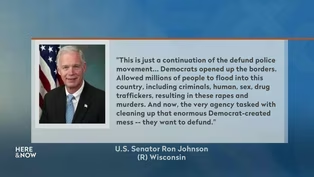
Baldwin, Johnson React to Homeland Security Funding Fight
Video has Closed Captions
Clip: S2400 Ep2429 | 1m 22s | Tammy Baldwin and Ron Johnson on Homeland Security funding given actions in Minneapolis. (1m 22s)
Here & Now opening for January 30, 2026
Video has Closed Captions
Clip: S2400 Ep2429 | 1m 5s | The introduction to the January 30, 2026 episode of Here & Now. (1m 5s)
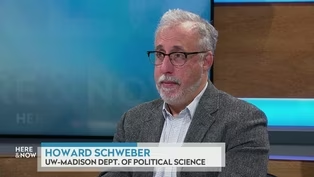
Howard Schweber on Protesting ICE and Constitutional Rights
Video has Closed Captions
Clip: S2400 Ep2429 | 12m 48s | Howard Schweber on the killings of Renee Good and Alex Pretti and the Bill of Rights. (12m 48s)
Witnessing — and Fearing — ICE Actions in St. Croix County
Video has Closed Captions
Clip: S2400 Ep2429 | 4m 2s | Immigration raids and protests are weighing upon communities in western Wisconsin. (4m 2s)
Wisconsin's 2026 Supreme Court Candidates on ICE and the Law
Video has Closed Captions
Clip: S2400 Ep2429 | 3m 56s | Maria Lazar and Chris Taylor on the role of courts concerning Homeland Security actions. (3m 56s)
Wisconsin's 2026 Governor Candidates Consider State Prisons
Clip: S2400 Ep2429 | 4m 41s | Candidates in the 2026 race for governor on a plan to overhaul the corrections system. (4m 41s)
Providing Support for PBS.org
Learn Moreabout PBS online sponsorship
- News and Public Affairs

Top journalists deliver compelling original analysis of the hour's headlines.

- News and Public Affairs

FRONTLINE is investigative journalism that questions, explains and changes our world.












Support for PBS provided by:
Here and Now is a local public television program presented by PBS Wisconsin