
New documentary from Dr. Henry Louis Gates, Jr. on Black and Jewish communities premieres on Detroit PBS
Clip: Season 54 Episode 5 | 12m 55sVideo has Closed Captions
Directors Sara Wolitzky and Phil Bertelsen talk connections between Black and Jewish Americans
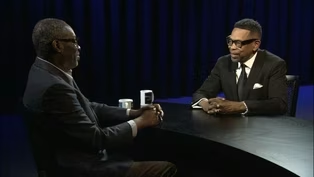
American Black Journal previews the new PBS documentary series from Dr. Henry Louis Gates, Jr. called "Black and Jewish America: An Interwoven History." Host Stephen Henderson discusses the film's content with its co-executive producers and directors, Sara Wolitzky and Phil Bertelsen. They explain why Dr. Gates chose to explore the historical relationship and connection between Black and Jewish Am
Problems playing video? | Closed Captioning Feedback
Problems playing video? | Closed Captioning Feedback
American Black Journal is a local public television program presented by Detroit PBS
New documentary from Dr. Henry Louis Gates, Jr. on Black and Jewish communities premieres on Detroit PBS
Clip: Season 54 Episode 5 | 12m 55sVideo has Closed Captions
American Black Journal previews the new PBS documentary series from Dr. Henry Louis Gates, Jr. called "Black and Jewish America: An Interwoven History." Host Stephen Henderson discusses the film's content with its co-executive producers and directors, Sara Wolitzky and Phil Bertelsen. They explain why Dr. Gates chose to explore the historical relationship and connection between Black and Jewish Am
Problems playing video? | Closed Captioning Feedback
How to Watch American Black Journal
American Black Journal is available to stream on pbs.org and the free PBS App, available on iPhone, Apple TV, Android TV, Android smartphones, Amazon Fire TV, Amazon Fire Tablet, Roku, Samsung Smart TV, and Vizio.
Providing Support for PBS.org
Learn Moreabout PBS online sponsorship- A new four-part documentary from Dr.
Henry Louis Gates Jr.
premieres tonight at nine o'clock here on Detroit PBS.
It's titled, "Black and Jewish America, an Interwoven History."
The docuseries examines the rich and complex relationship between black Americans and Jewish Americans throughout history.
Here's a preview.
- When I was growing up, I only thought of race in terms of black and white.
It wasn't until much later when I learned about antisemitism that I realized blacks and Jews face common enemies.
But when we stand together, we are a formidable force.
- The relationship between African Americans and Jews in the United States, it's not a simple story, and it cannot be a simple story.
- It's got a really long history.
- When these two communities get together, and they synergize creatively or politically, they're a juggernaut, and they can't be stopped.
- Jewish people have always been some of the first outside of the culture itself to embrace black music.
- A white Jewish producer, and the greatest black jazz singer of all time.
Why can't the world be like this?
(crowd shouting) - Rabbi Heschel just told me, "He might not live because the killing folk in Selma."
- I think the Civil Rights Movement healed our souls after Nazi Germany.
- There was a very visible black Jewish alliance during the Civil Rights Movement.
- That relationship accomplished incredible things.
- But I don't wanna romanticize the alliance because it wasn't an untroubled relationship.
- We want black power.
- There is a profound sense of the Jews are the haves, the blacks are the have-nots.
Nothing has separated the Jewish and the black community more than this issue of affirmative action.
- It's dangerous to make it all the same.
We're not the same.
We come from different histories.
- I don't consider myself white.
And when I once told our class that, they laughed in my face.
- We laughed.
(laughing) - You laughed in my face.
- I did.
- [Reporter] Blacks and Jews in the Crown Heights section of Brooklyn clashed, inflamed by the death of a young boy.
- The old alliance between blacks and Jews, is that in jeopardy now?
- Very much so.
- We must not allow the relationship between Jews and African Americans to suffer.
- The whole purpose of this meal is to let you know we are Jews too.
- [Reporter] In Charlottesville, violent protests broke out at what was supposed to be a white nationalist rally.
- When you see Charlottesville, you see that most people that are anti-semites are also racist.
- [Protesters] Black lives matter!
- When everything blew up on campus, I wasn't sure about how I would navigate the conversation.
- We have to find a way to listen to all the rancor, even when it makes us uncomfortable.
(protesters cheering) - It's dangerous 'cause it's a really hard time to talk about either black people or Jewish people.
It's just become fraught in so many ways, but anything that's dangerous is worthwhile.
(calm foreboding music) - Sara Wolitzky and Phil Bertelson, directors and co-executive producers of "Black and Jewish America."
It's really great to have both of you here on "American Black Journal."
Thanks for joining us.
- Hey, thanks for having us.
- Thank you so much.
- So, Sara, I'll start with you.
This is a story that is very familiar to us here, of course, in Detroit, given the large populations of African Americans and Jewish Americans here, and the history between them.
But talk to me about why this is such a relevant story to tell now.
What is the sort of modern urgency of this tale?
- Well, I think, in many ways, it's always relevant that it has become increasingly more so for Dr.
Henry Louis Gates, our, you know, host and executive producer of the show.
You know, the turning point for him feeling the urgency was really Charlottesville.
Charlottesville coming on the heels of the Mother Emanuel Charleston shooting.
And then not that long after, we saw things like Tree of Life.
And I think, it's undeniable to all of us that there is a resurgence of a sort of unapologetic white nationalism in this country.
And one that has always sort of targeted both these two peoples in it's cross hairs in a way that's connected and separate.
And so, we thought it was really an important moment to look back at the history of how these two peoples have both experienced that, but how that's often connected us never perfectly, never without tension, but has produced a lot of incredible things for this country.
And the moment of general divisiveness, not just between these groups, but efforts to try to sow divisiveness in this country.
The, you know, what's possible, when you can feel this cross-cultural solidarity.
Phil, anything you wanna add to that?
- No, I completely agree.
- Okay.
(laughs) - Yeah.
- Yeah, so, let's talk about that allyship though, and that closeness, you know, as I said here in Detroit, we're extremely familiar with that.
Phil, talk about how the allyship and the connection sort of supersedes, I think, in many ways the commonality that both communities have with oppression and marginalization.
In other words, there is a connection that has nothing to do with the hardship that both communities feel.
There is a genuine crossover that dates back decades, if not longer.
- Yeah, no, absolutely.
And in fact, it's foundation is rooted in a shared oppression, different experiences of oppression and, you know, exile.
But those common histories are what brought Black and Jewish communities together in the early 20th century in the United States.
And when you say you're no stranger to it in Detroit, we're no strangers to it in New York.
We're no strangers to it in Chicago.
These major urban hubs were where these communities first began to flourish.
And as you know, one scholar says in the series lived, "Cheek to jowl" for some time.
But, you know, with the advance of suburbanization, you know, those communities separated.
And so, we find ourselves now no longer living side by side necessarily, but certainly having an allied view of what, you know, democracy is.
And I think Black and Jewish Americans have done a disproportionate amount of work to ensure democratic principles are upheld, and that this is a nation of laws and, you know, with equality in mind.
And it was that allyship that really shaped the civil rights movement and advanced many of these common values that we now hold dearly, but find slipping away.
And it's no wonder, I guess, you should, I could say that it's the division that is being sown that allows those democratic principles to feel elusive or at least, you know, evasive at this point in time.
So, you know, I think this film, you know, will go a long way to reminding people about those foundational and shared experiences that have made Black and Jewish Americans a particular group of people.
- Yeah.
- I'll also just jump in and say that- - Go ahead.
- you know, it's politics and it's civil rights and all that, but it's also cultural.
And a lot of, you know, Phil directed episode two of the series, which focuses a lot on jazz and that era and Harlem Renaissance and later years and music and film, and so many cultural things that feel quintessentially American would just not exist without these two groups and the partnership between them in a lot of places.
So, yeah, it does go deeper than that.
And, you know, comedy and sports, and all of these things, the motivation behind it might come from sort of this sense of otherness sometimes, but it converts into really incredible cultural products.
- Yeah.
Sara, the tension that you mentioned at the top of the interview, the tensions that both communities are feeling, given the sort of sociocultural and political events that we're all living through, is this a moment of sort of return to more of that connection between the communities and allyship?
Certainly, we see tensions that are playing out but is there a reckoning, I guess, kind of moment around while we're both in the same kind of position, again, in a different way than was true for a long time?
- Yeah, I mean, I think that it's certainly, we hope, the film doesn't have an agenda.
It's a historical look, but I think, personally speaking, we hope, certainly it's a moment of return, but a moment, you know, but a moment of return, I think, you can only build a relationship off of this honesty and this sort of truth and reconciliation of what are the factors that cause that tension.
And there are different, you know, it's not a, just a kumbaya thing.
There are differences and there might be some things that we're never gonna agree on, right?
But as Dr.
Gates always likes to say, you know, "Coalitions can't have litmus tests, and we have to find a way to agree to disagree on certain things because every successful coalition has done that."
And so, I think, we do hope this film, part of telling the history is allowing that process of, you know, laying it all on the table and being honest about all the things that have brought us together and divided us and not telling anyone what to think, but allowing that conversation to spark because it's very obvious.
I think it's only becoming increasingly obvious how much we need each other.
- Yeah, yeah.
Phil, what do you hope people take from this film who are not part of either community?
Obviously, the two communities, I'm sure, will really appreciate this exposition of the relationship, but if you're not a member of one of the communities, what is the sort of lesson, I guess, to take from this work?
- That's a great question.
I, you know, personally, I think, it's to piggyback on what Sara said, it's really a lesson in how to agree to disagree.
You know, we end at UCLA with an organization called Dialogue Across Difference.
And there's a lot of difference, and the diversity of this country is what makes it great.
And I think until diverse communities can learn to dialogue and talk to one another, not at one another, commune together and not against one another, the lessons that black and Jewish Americans have to teach won't be learned.
So, I think, the greater good is served by our shared and interwoven history where there are lots of lessons on how to form coalitions and build a better America.
- Yeah.
Yeah.
Hey, Sara Wolitzky and Phil Bertelson, directors and co-executive producers of "Black and Jewish America."
Really great to have both of you here on "American Black Journal" with us.
Congratulations on the work and thanks for joining.
- Pleasure.
- Thank you so much for having us, Stephen.
- Hope you enjoy the series.
Video has Closed Captions
Clip: S54 Ep5 | 11m 6s | Gerald McBride has been a fixture in broadcasting and production for more than four decades. (11m 6s)
Providing Support for PBS.org
Learn Moreabout PBS online sponsorship
- News and Public Affairs

Top journalists deliver compelling original analysis of the hour's headlines.

- News and Public Affairs

FRONTLINE is investigative journalism that questions, explains and changes our world.











Support for PBS provided by:
American Black Journal is a local public television program presented by Detroit PBS