
Radio personality Gerald McBride releases memoir chronicling how faith and resilience guided his professional journey
Clip: Season 54 Episode 5 | 11m 6sVideo has Closed Captions
Gerald McBride has been a fixture in broadcasting and production for more than four decades.
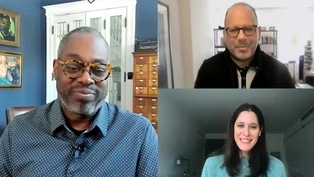
American Black Journal is kicking off Black History Month by talking with veteran Detroit broadcaster and filmmaker Gerald McBride whose career in Black radio has spanned more than four decades. Host Stephen Henderson talks with McBride about his new memoir titled, "God and the DJ," which chronicles McBride's professional path as a radio personality and the role faith and resilience played.
Problems playing video? | Closed Captioning Feedback
Problems playing video? | Closed Captioning Feedback
American Black Journal is a local public television program presented by Detroit PBS
Radio personality Gerald McBride releases memoir chronicling how faith and resilience guided his professional journey
Clip: Season 54 Episode 5 | 11m 6sVideo has Closed Captions
American Black Journal is kicking off Black History Month by talking with veteran Detroit broadcaster and filmmaker Gerald McBride whose career in Black radio has spanned more than four decades. Host Stephen Henderson talks with McBride about his new memoir titled, "God and the DJ," which chronicles McBride's professional path as a radio personality and the role faith and resilience played.
Problems playing video? | Closed Captioning Feedback
How to Watch American Black Journal
American Black Journal is available to stream on pbs.org and the free PBS App, available on iPhone, Apple TV, Android TV, Android smartphones, Amazon Fire TV, Amazon Fire Tablet, Roku, Samsung Smart TV, and Vizio.
Providing Support for PBS.org
Learn Moreabout PBS online sponsorship(bright upbeat music continues) - Welcome to "American Black Journal."
I'm your host, Stephen Henderson.
It's Black History Month, and my first guest was instrumental in helping to shape black radio here in the city of Detroit.
Gerald McBride has been a fixture in broadcasting and production for more than four decades.
His old-school, house party radio show is heard in more than 32 markets all across the country.
And now, McBride has released his memoir titled, "God and The DJ."
It chronicles how faith and resilience guided his professional journey.
He is also the filmmaker behind the award-winning movie, "Black Ice, The Rhythm," which tells the story of young black hockey players from the inner city.
I am really pleased to welcome, Gerald McBride, to American Black Journal.
- [Gerald] Man.
- It's great to have you here.
- Man, thank you so much for having me My first time.
- You're an institution.
- Oh, wow.
- How have you not been on this show?
That's a great question, right?
- Oh, no, I dunno.
I'm just so excited to be here.
Thank you so much for having me.
- So, let's start with the memoir, of course.
- Yeah.
- "God and The DJ."
I'm gonna say this, it's an unusual title for somebody in the industry that you're in to use, to tell his story.
- Yeah.
- So, tell me how you came to that.
- Well, you know what?
Actually, this was motivated by a cousin of mine who called me a few years ago and said, "Hey, you know, I'm putting together a family book and, you know, just a photo book, but I'd like to get some information on a few of our relatives."
And she asked me to write a couple of paragraphs.
- Right.
- You know, which I think is a good idea for all families to do that.
- Yeah.
- You know, just so generations can go through and see who this person was and, you know, how you ask those questions.
Hey, ma, who was my so-and-so uncle or whatever?
- Yeah.
- You know?
A lot of times, you know, our parents didn't have the answer.
So, anyway, she asked if I could write a couple of paragraphs, and I just started writing, Stephen- - Yeah.
- and I kept writing and writing.
I was like, wait a minute.
I think this is going to be a book.
- This is gonna be a book.
Yeah.
- And I contacted a friend of mine who put me in touch with a publishing company, and it was a small publishing company.
So they kind of just walked me through the entire steps of writing this book.
And when I started explaining and sharing some of my stories, they were like, "We think you have something that's really interesting here."
- [Stephen] Yeah.
- I was like, "Really?"
- Okay.
(chuckles) - Yeah, yeah.
But the role of God and faith and resilience in that.
- Yes.
- I think is the, is the kind of pleasant surprise.
- Yes.
Yes.
- It's an industry that doesn't always align itself with those kind of ideas.
- Absolutely.
And, you know, here's the thing.
I think, a lot of people hear us on the radio, and we're having a good time.
- Right.
- Which we do.
- Right.
- You know, we're laughing, and we're joking, and we're playing songs, but, you know, sometimes our lives behind the scenes can be really interesting and.
- [Stephen] Yeah.
- And sometimes, tragic.
- [Stephen] Yeah.
- And, you know, I went through a lot in my life, and I just wanted people to understand the twist and the turns and really, how I was rescued by God in my life.
- [Stephen] Yeah.
I mean, I think, for me, one of the things that kind of shines in the text is that idea of you're never finished with- - Right.
- whatever it is you're doing.
- Right.
You might make terrible mistakes.
You might have bad judgment about something or- - Absolutely.
- or find yourself in a terrible situation, but you're not done.
You always have a chance to do more or to correct what you did.
- Absolutely.
- Talk about how you've come to that idea- - Yeah.
- over that four decades.
- Well, if I could just tell you just kind of just one story.
After graduating outta Specs Howard School of Broadcasting, I had been waiting to be on the radio all my life.
And my mother played the radio constantly in the house.
And so, we grew up listening to WCHB and WJOB.
I became a sole team reporter at WJOB and worked on the Donnie Simpson.
(Stephen laughing) And man, you know, after being in that environment and watching, especially Donny, I'm just like, "Man, I have got to do this."
- I wanna do this?
- Yeah.
I have got, this is what I wanna be.
And I went to Spec Howard School of Broadcasting and started sending out tapes after I graduated.
And it took me a while to get a job.
You know how it is in broadcast.
- Yeah, yeah, yeah, yeah.
- It's not like you just soon graduate- - You don't just roll up.
- And get a job.
- (laughing) That's right.
- Anyway, you know, after getting so many nos, I finally get a, yes, from a radio station in Flint, Michigan called WAMM.
And the program director said, "Hey, look, we got a part-timeship for you from three to six in the afternoon."
I was like, "Yes, this is it.
I've been waiting on this all my life."
I would go up there for an orientation the week before my shift on that Saturday and sit in with one of the other DJs.
And back then, you know, Stephen, they had all of these knobs, you had turntables, you had cart machines, you had all of these things that you had to remember which buttons did what.
- The studio was like an assembly.
- It really was.
- Yeah.
(laughing) - Man, it was really something back then.
Everything, of course, is computerized.
It's like easier now.
But, yeah, so, I had to learn all of these different things.
So, Saturday rolled around, and I'll never forget standing in that studio while the other DJ was on, and he said, "Up next is Gerald McBride."
And he got out of the seat, and it was my turn, and I was like, "Oh no, this is it.
- (laughing) What do I say?
- What do I say?
What do I," Stephen, I forgot everything I was supposed to do.
- Oh, no.
- Anyway, I sit down in the chair and cue up my record turntables were.
Actually, you had to reach really way back in order to start the turntable.
And I remember getting ready to turn on that mic, and I reached back to start my record, and I knocked the arm off the record, and it goes, (imitates scratching noise) over the air, and the program program director runs into the studio and says, "You're fired" before I can say my first words.
- (laughing) Right, yeah.
I can't do it.
- So, yeah.
Yeah.
(laughs) So, but, you know, I learned right then and even, and the reason why I told that story, you know, even though you may make some mistakes in life and even something that I had just been looking forward to, so excited about doing, God gave me another chance.
- Yeah.
- Yeah.
And I really didn't know God then.
- Yeah.
- But He was still a part of my life, even when I didn't know Him.
A friend of mine worked at the radio station and called me and said, "Hey."
Three months later he called me back and he says, "Hey, man, I talked to program director into giving you another chance."
And I go back on and, of course, the rest is history.
- Yeah, right?
- Here I am, 45 years later, 45 years later, here I am on the air.
- Yeah.
- Yeah.
But there would be things like that throughout my life that would happen.
And I think people will probably read this book and like, oh no, this guy is just messing up, just over and over and over again.
- That's okay.
- But that's okay.
You just have to get back up.
- Gotta keep going.
- And keep going.
Absolutely.
I'm sure you have some stories too, huh?
- Well, not ones I wanna tell on air.
(both laughing) - Right.
I'll let the skeletons out of the closet.
- Yeah, right.
Right?
- Okay.
Yeah.
- So, four decades in- - Yeah.
- how does it look different to be doing the work now for you than it did when you were younger and making those mistakes?
- Well, you know, it looks a lot different.
I think, radio was a lot different, first of all.
- Yes, of course.
- I mean, with technology, the choices that people have is, you know, back when radio, when I was growing up, we depended on the radio.
I mean, it was our place for information for the community.
- Yeah.
Yeah.
- I think, radio is more of a background.
I'm fortunate enough to have a show where older listeners listen to me, I'm playing, well, I shouldn't just say that.
We got some young people listening too.
- Yeah.
- But, yeah, it's a little different now.
But I can say that I'm very fortunate to have a show that people make an appointment to listen to on the weekends.
- I think that's really important, right?
- Yes.
- The intentionality that goes along with listening.
- Yes.
- Right now, especially the radio, but, you know, it's all streaming over the internet.
- Absolutely.
- Anyway, but to say, at this day, at this time, I'm gonna sit and listen.
- Yes.
- It's more important now than it used to be, I think.
- Yes.
And the show is really like, Stephen, if you ever invited your friends over and put out all your old albums instead, hey, you guys remember this, you remember that?
- Just listen to this.
Right.
- Yeah.
When we were growing up, we listened to that song and The Temptations were singing this and Earth, Wind, and Fire, and the Isley Brothers.
And then we throw a battle in there like, "Okay, let's put Earth, Wind, and Fire against the Isley Brothers, and let's see who wins.
- Right.
- How many people are voting for the, I mean, it really, and that's the reason why I call the show the old-school house party because that's exactly what it is.
It's just a party on the radio where we just pulling out all the old songs that everybody remembers.
And these songs are, you know, 50 years old that I'm playing.
I mean, Earth, Wind, and Fire, that's the way the world, it's 50 years old, you know?
- (laughing) It's unbelievable.
- So, yeah.
(laughing) - So I'm gonna ask you this.
How much longer do you think you'll do it?
You're doing some other things now.
This film that you were involved in?
- I am.
I am.
- Does radio still have your absolute love and attention?
- You know what?
It does.
- Yeah.
- It still does right now, but I'm willing to do it as long as I possibly can.
Of course, things change, but I'll continue to do this show as long as the radio stations will have me.
- [Stephen] Yeah.
- And as long as the listeners will continue to listen to me.
But, yeah, I am trying to make a transition into film.
I have a movie out called, "The Rhythm" that is available on Amazon Prime and Apple TV and- - Black kids playing hockey.
- Black kids playing hockey.
- [Mr.
Palmer] Where'd you learn to skate like that?
- [Buck] Father taught me.
- Good job, son.
- Any interest in playing with us?
- Me playing with a bunch of white guys?
My father was murdered right in front of me.
- I got you in here in the first one.
- I got into a fight on the ice.
- I didn't even think black people played hockey.
- I get the idea for that movie after a client of mine who I did or still do radio commercials for comes into town and asked if I could take him to a hockey game.
And we end up at University of Michigan where his son was playing for UMass.
And I'm the only black guy in the entire arena.
And I'm thinking, "Wow, world of black people in this sport."
So, it kind of roused my curiosity.
But I think right then and there, God gives me an idea for a movie.
I mean, I just, when you get an idea for a story, - Right, Yeah.
No, you can't.
- You just, you gotta let it out.
You gotta tell people about it.
And I just kept writing and writing, and it turns into a movie and- - Yeah.
That's amazing.
- here we are.
- Yeah.
- Yeah.
- All right, well Gerald, congratulations on the book.
- Thank you so much.
- The film and thanks for being with us.
- Yeah.
Thank you so much for having me, Stephen.
Video has Closed Captions
Clip: S54 Ep5 | 12m 55s | Directors Sara Wolitzky and Phil Bertelsen talk connections between Black and Jewish Americans (12m 55s)
Providing Support for PBS.org
Learn Moreabout PBS online sponsorship
- News and Public Affairs

Top journalists deliver compelling original analysis of the hour's headlines.

- News and Public Affairs

FRONTLINE is investigative journalism that questions, explains and changes our world.












Support for PBS provided by:
American Black Journal is a local public television program presented by Detroit PBS