
A discussion about the relationship between Black and Jewish communities in Detroit
Clip: Season 54 Episode 12 | 13m 21sVideo has Closed Captions
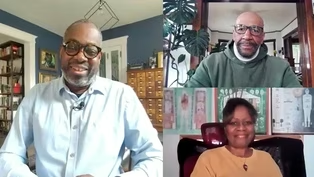
The conversation was moderated by The Skillman Foundation President and CEO Angelique Power.
American Black Journal has highlights from a panel discussion at The Wright Museum held in conjunction with the Dr. Henry Louis Gates documentary "Black and Jewish America: An Interwoven History." The conversation with historians and faith leaders explored the relationship between Black and Jewish communities in Detroit and was moderated by The Skillman Foundation President and CEO Angelique Power
Problems playing video? | Closed Captioning Feedback
Problems playing video? | Closed Captioning Feedback
American Black Journal is a local public television program presented by Detroit PBS
A discussion about the relationship between Black and Jewish communities in Detroit
Clip: Season 54 Episode 12 | 13m 21sVideo has Closed Captions
American Black Journal has highlights from a panel discussion at The Wright Museum held in conjunction with the Dr. Henry Louis Gates documentary "Black and Jewish America: An Interwoven History." The conversation with historians and faith leaders explored the relationship between Black and Jewish communities in Detroit and was moderated by The Skillman Foundation President and CEO Angelique Power
Problems playing video? | Closed Captioning Feedback
How to Watch American Black Journal
American Black Journal is available to stream on pbs.org and the free PBS App, available on iPhone, Apple TV, Android TV, Android smartphones, Amazon Fire TV, Amazon Fire Tablet, Roku, Samsung Smart TV, and Vizio.
Providing Support for PBS.org
Learn Moreabout PBS online sponsorshipLet's turn now to a recent screening and panel discussion based on the PBS documentary series from Dr.
Henry Louis Gates Junior.
It's titled "Black and Jewish America in Interwoven History."
Detroit PBS and the Charles H. Wright Museum of African-American History teamed up to host an event that explored the relationship between the Black and Jewish communities here in Detroit.
Highlights from the PBS series were shown and a group of historians and community leaders discussed the local connection.
Here's a portion of that conversation.
- It is my privilege to be your moderator this evening for, as Neil said, this timely discussion and an overdue discussion.
Rich mentioned that I am in fact Black and Jewish.
I'm proudly both.
And to this day, people are so surprised by that fact.
You're Black and Jewish?
(audience laughs) You know, when I was younger, there were the Sammy Davis Jr.
jokes that reigned supreme.
In college at the University of Michigan, it was not uncommon when I said to someone about my identity to be asked to prove it.
(speaking in foreign language) I would immediately jump in to do so in my 20-year-old people-pleasing brain.
But the reality is that the reason it created so much surprise within our communities, the reason that it created a demand for proof was the perception that our communities are so disparate.
That we can't even believe that that deep of a connection exists.
Realistically, there are many of us.
There are over a million Jews of color in the United States.
That is 15% of the Jewish population here.
And there are quite a few of us in Detroit as well.
Ken, let's start with you.
I want you to take us from kind of share some of the reflections of what you've seen.
But also translate it to Detroit.
What is similar and what's different?
- Thank you for having me, first of all, and I have to now capitalize what Dr.
Gates has talked about a lot of his time.
But brilliant, brilliant four-part series.
Hope that you've seen all of it.
You certainly got a good glimpse of it today.
How many people have had an opportunity to see at least one part of the series?
It is brilliant.
Yeah, it's a great, great, great show of hands.
I would say, Angelique, for the most part, there are great similarities in the vast set of experiences over several decades that you saw in the documentary.
There's some vast similarities in Detroit's experience or Metro Detroit's experience.
But I would also say, Detroit's got flavor like nobody else.
And there are, I believe, some significant differences along the path of Black and white Jewish relations here in Detroit proper, and to some extent Metropolitan Detroit.
And I know we'll get into more of that as we go through the panel discussion and the Q&A.
I would just say, I would lift up one difference that made Detroit's experience with Blacks and Jews a little different than what you saw in New York City and what you saw in the American South.
And that's the Labor Movement.
Great synergy, friends, if we think about it.
Great synergy between Blacks and Jews in the Labor Movement.
After all in Detroit, we built things and then we organized.
And side by side with Gentiles of a certain political persuasion, Jews and African Americans partnered, created a coalition in labor organizations and in labor organizing.
- Catherine as a historian, you also have created an exhibition.
And you looked at Hastings Street in particular and told the story of Jewish immigrants that have moved to Hastings.
But you also told another story as part of that.
Will you talk to us about that?
- Sure.
So, this was an exhibit we created, a Jewish historical society at the Detroit Historical Museum in 2024.
It was focused heavily on the Jewish experience in this neighborhood.
And this was where Eastern European immigrants and others settled, especially in the late 19th century.
But you may know this neighborhood better as Black Bottom and Paradise Valley when they were Black majority neighborhoods, particularly after World War I. So we wanted to highlight the full history of this neighborhood, talk about the Jewish chapter, which often omitted, but also take it through its destruction.
And then the conversation today about reparative redevelopment.
And we knew those were not stories that we could tell.
So, we partnered with Black historians and archivists.
Alas, not Ken Coleman.
Next time.
(audience applauding) But that committee really drove that portion of the exhibit.
The themes, the emphases.
And then, we were working them back through the rest of it.
And so, I'll just highlight two things because the emphases were really on moments of cooperation, but also moments of tension.
So, in the 19th centuries, Jews and African Americans were living together in this neighborhood, starting in the 1840s.
A great example of sort of living side by side in this neighborhood is that Detroit's second Jewish congregation, Shaarey Zedek, which is still around today, founded in 1861, bought its first building in 1864.
And it bought St.
Matthew's Episcopal Church at Congress in St.
Antoine, which was Detroit's third Black church.
So an example of the Black community outgrowing a space and the Jewish community moving in.
The other thing that we'll highlight is the committee that worked on the Black Bottom and Paradise Valley portions of the exhibit felt it was very important to showcase the poetry of Robert Hayden, poet laureate on faculty at U of M for many years.
African American, grew up in the neighborhood, lived next door to the Jewish Community Center on Hastings Street, had a number of Jewish friends as a child.
And his poetry concerns the experiences of being in this neighborhood, the difficult experiences.
On the one hand, he's close with these Jewish children, he knows a lot about Jewish holidays and traditions.
He's interested in going to synagogue and tries to go with his friends to synagogue.
And he's prevented from doing that by the rabbi.
And this is a devastating moment for him.
It's a moment when he's made aware that he's not like his friends.
And he had to come to terms with that devastation.
- We have two faith leaders that actually work and for the last decade have intentionally worked together.
- My name is Pastor Aramis Hinds.
And I'm the lead pastor of Breakers, now Breakers Church.
Used to be Breakers Covenant Church International.
And I've been pastoring for 24 years come April.
(audience applauding) I started when I was five, but... (audience laughing) But besides that, we've been in Detroit serving in community for the entire time, starting on the east side of Detroit.
And we've worked our way right to the center of Detroit.
And we happen to currently be in the last home of the first known Jewish congregation in the entire state of Michigan.
And that is Temple Beth El.
For those that know about Lighthouse Cathedral, it became home for Lighthouse Cathedral, which was the first interracial church to come into that space.
It was well known.
- So, I have had the privilege of serving as the rabbi at the Downtown Synagogue for almost 10 years.
Not quite 24 yet.
Please, God.
One day.
And one of the things that's amazing about the Downtown Synagogue is our commitment to the city of Detroit.
That we are the only freestanding synagogue in the city of Detroit.
And we are committed to being place-based and to being in partnership with our neighbors.
And loving your neighbor is not a foreign concept in the religious tradition, right?
It's very deeply integral to what we believe and to who we are.
And recognizing when I first started that a lot of my neighbors were strangers.
And that part of what I wanted to do was to change that.
Was to change the relationship despite the fact that in Jewish tradition and in our sacred tradition, loving the stranger's important.
There's something different about having (speaking in foreign language) about having your neighbor, your kindred, be part of your life.
And so, I was committed to meeting different people in different communities in the city of Detroit.
And I had the unbelievable privilege of meeting Pastor Aramis Hinds at an event that was actually commemorating the anniversary of the march on Selma.
So, bringing history and present and future together, we decided that it was important that our communities got to know each other a little better.
- I really appreciated that the documentary dealt with the fraughtness also between these communities.
And that they named some of the difference is in how each community has experienced oppression.
In the Black community, it is an obvious fist.
It is lynching, it is systemic racism, it's mass incarceration, it's red lining, it's all of those things.
In the Jewish community, it is more of a malignant cancer that is always dwelling beneath the surface.
If you look at YouTube or Twitter, you're always at most two clicks away, two scrolls away from the most anti-Semitic content and the most racist, anti-Black racist, and other racist content.
And yet it seems because the experiences are so different, it feels hard to find alliance or to see the similarity.
And so, what's the solution?
(audience laughing) - I have the solution.
- Thank you.
(laughs) - No, I don't have a solution, but I know what has been working.
And it was my privilege to meet Ken today.
But I'm happy to say I've already met Catherine and I already have a really good relationship with Rabbi Silverman because we're actively doing the work of building relationships and building bridges.
And so, I talk about the term "intentional proximity."
And part of the challenge, even in the faith community, is often, and it was mentioned, we live in silos, right?
We're taught to stay and don't go past this boundary or the boogey monster's gonna get you, right?
We're told to love, but then we're told not to go so far where you might need to love.
And so, part of the challenge for me as a pastor was when I realized that I treat my coworkers better than I treat people of a different culture, a different faith.
And how can I be living out my faith if that be the case, you know?
And that was a aha moment for me when I realized that to care for others, to cool the lump, to help heal the world, what was necessary was that we had to challenge, we had to put some muscle to our faith.
Or as Rabbi Heschel said, that he felt like his feet were praying.
And it's when we begin to take these concepts and ideologies that we have about life, which in many cases in proximity like today, what happens is you realize that there's a far more amount of similarities and differences.
You look at individuals in their eyes, you listen to that, their heart with your heart, and then all of a sudden you can never look at them the same again.
 New
NewA conversation with Tyree Guyton, the Detroit-born artist known for creating The Heidelberg Project
Video has Closed Captions
Clip: S54 Ep12 | 10m 31s | ABJ talks with this year’s Kresge Eminent Artist about being selected for this special honor. (10m 31s)
Providing Support for PBS.org
Learn Moreabout PBS online sponsorship
- News and Public Affairs

Top journalists deliver compelling original analysis of the hour's headlines.

- News and Public Affairs

FRONTLINE is investigative journalism that questions, explains and changes our world.











Support for PBS provided by:
American Black Journal is a local public television program presented by Detroit PBS