
A look at Venture 313, more from “Faith in Detroit”
Season 54 Episode 31 | 26m 46sVideo has Closed Captions
How Venture 313 is helping Black tech founders and a story from "Faith in Detroit.”
We’ll tell you about an initiative that is helping African American-owned tech companies get access to capital and other resources. Plus, the owner of “Sweet Potato Sensations” talks about the role faith played in her growth as an entrepreneur.
Problems playing video? | Closed Captioning Feedback
Problems playing video? | Closed Captioning Feedback
American Black Journal is a local public television program presented by Detroit PBS
A look at Venture 313, more from “Faith in Detroit”
Season 54 Episode 31 | 26m 46sVideo has Closed Captions
We’ll tell you about an initiative that is helping African American-owned tech companies get access to capital and other resources. Plus, the owner of “Sweet Potato Sensations” talks about the role faith played in her growth as an entrepreneur.
Problems playing video? | Closed Captioning Feedback
Where to Watch American Black Journal
American Black Journal is available to stream on pbs.org and the PBS app.
Providing Support for PBS.org
Learn Moreabout PBS online sponsorship- Coming up on "American Black Journal," we'll tell you about an initiative that is helping African American known tech companies get access to capital and other resources.
Plus the owner of Sweet Potato Sensations talks about the role faith played in her growth as an entrepreneur.
Stay where you are.
"American Black Journal" starts right now.
- [Narrator] Across our Masco family of companies, our goal is to deliver better living possibilities and make positive changes in the neighborhoods where we live, work, and do business.
Masco, a Michigan company since 1929.
Support also provided by the Cynthia and Edsel Ford Fund for Journalism at Detroit PBS.
- [Narrator] The DTE Foundation is a proud sponsor of Detroit PBS.
Through our giving, we are committed to meeting the needs of the communities we serve statewide to help ensure a bright and thriving future for all.
Learn more at dtefoundation.com.
- [Narrator] Also brought to you by Nissan Foundation.
And viewers like you.
Thank you.
(upbeat music) - Welcome to "American Black Journal."
I'm your host, Stephen Henderson.
August is National Black Business Month, a time to celebrate and support African American entrepreneurs.
The Detroit-based Venture 313 is assisting Black tech founders by providing access to capital, mentorship, and other much needed resources.
The initiative is funded by the Gilbert Family Foundation and operates through three organizations, TechTown Detroit, Invest Detroit Ventures, and the Detroit Development Fund.
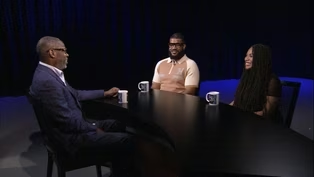
Joining me now is one of the managing partners, Belvin Liles of ID Ventures, along with Karissma Yve, who is the founder of Gildform and a recipient of Venture 313's support.
Welcome both of you to" American Black Journal."
You know, it seems like every month I'm talking with somebody about the access to capital issue that we have with African American businesses.
I mean, it is, I think, one of the kind of premier issues.
I'm a small business owner.
I am familiar with some of those challenges.
But let's talk about how Venture 313 kind of approaches this maybe differently than some of the other organizations that are trying to fix it.
- Yeah.
So you mentioned three different partners.
You have Invest Detroit Ventures, which is the equity kind of venture.
Dilutive side, you have TechTown Detroit, which is the non-dilutive grant funding side, and Detroit Development Fund, which is the the loan side.
And so amongst those three partners, we're able to have a capital continuum where folks can receive different types of financing depending on their needs.
But not just with capital, you know, it takes more than just capital to help support these founders.
So we also figure out creative ways we can wrap other resources around them and help them grow and matriculate.
- Yeah, what are some of those other, some of those other resources?
- Yeah, whether it's different workshops, whether it's product development, sales and marketing, executive coaching.
Sometimes we help hire fractional support for founders.
We help sponsor them to go to different events like a South by Southwest or AFROTECH.
So you know, right now, we're running different AI build nights through TechTown Detroit where folks can come in, and whether you're in the beginner level or more advanced state, learn how to leverage AI to help support your business.
So a multitude of different ways.
And fortunately we've been able to assist Karissma and Gildform with some of those resources as well.
- Yeah.
Yeah.
So tell me about Gildform.
- Yeah, Gildform is a AI product creation infrastructure and platform.
- Okay.
- So essentially we help creators and brands small, medium-sized businesses, as well as some of the world's largest enterprise companies from fashion to entertainment turn their product ideas into reality, literally starting with just an idea.
So the way that that works is they come to Gildform onto the platform.
They come with an idea in the form of a sketch, a reference image, a few simple words, and our patented technology will then turn that idea into a product that's ready for manufacturing.
And we didn't stop there.
We actually do manufacturing.
So we have a factory here in Detroit- - Wow.
- that's really creating products end to end, starting from 3D printing, doing the casting, the polishing, you name it.
And the type of products that we're focused on is hard goods.
So you can think jewelry, fashion hardware and trims such as buttons, super pulls, belt buckles, collectibles, figurines and home decor.
- Yeah.
So what led you to this work?
- So I've always been a creator at heart.
And I think that ever since I was, I think it started when I was about 14 years old, I decided that I had a, like, vision.
I needed to make something.
And oddly enough, it started with a button.
And I became obsessed with how buttons were made.
And I was like, well, how do I make a button?
But not just any button, I wanted a precious metal button.
I wanted it to be made of silver.
- Okay.
- And I, growing up on the west side of Detroit, you know, I think that was an odd sort of request as a 14-year-old going to your parents like, "I want-" - A silver button.
- "I want to make a silver button."
They're like, "Okay, how do you make that?
What do you do?"
And I remember my mom was like, "Yeah, sure.
You figure out how to do it.
You do whatever you want, sister girl.
More power to you."
And I took that as a bit of a challenge and I figured out how to do LA Swags casting.
And before I knew it, I had a nice little casting operation in my basement.
And from there, I discovered the power of product creation.
- Yeah.
- I think that ideas are like the most important thing known to humanity.
I think the reason that we're here today is because of people's ideas.
- Yeah.
- And I thought about like that gap between like me having my ideas.
And if I didn't have the willpower, if I didn't have just this crazy obsession to like figure out how to make my ideas real, that idea wouldn't have come into fruition.
- Sure.
- And I just became obsessed with this like, you know, ideas that are this process that, ideas typically go uncreated.
They go unrealized.
- Yeah.
- And with Gildform, I wanted to remove that barrier completely.
- Wow.
And so 313 Ventures is really moved you to the ability to make that work, right?
I mean you're manufacturing.
I know how expensive that is.
And then you're doing all of these other things.
I mean, without this would that have been possible?
- Yeah, no.
So when I think about ideas, and I said, ideas are the most important thing known to humanity.
Guilform is a big, was a big idea.
It was, I want to create technology.
I want to redefine and disrupt the way that products are made.
Essentially disrupting an entire supply chain and democratizing it.
Giving access to anybody to make anything, no matter what their budget is, no matter what access to equipment or machinery that they have.
But in order to do that, I essentially needed to be that.
And Venture 313 really was able to bridge that gap for me in my idea and make my idea real.
- Yeah.
- So that I can... And so essentially we can empower a world of small, medium-sized businesses ideas, as well as enterprise companies and make their ideas real.
And so I think about Venture 313's support and not just supporting me or Gildform, but also supporting the thousands of creators that are creating on our platform.
- Yeah.
Yeah.
You know, one of the things that occurs to me about her story is, I didn't know anything about that business until she just told me about it.
You're giving a platform, I think, to people who wouldn't otherwise have it so that people know Detroit.
And they know what we're doing here in Detroit and they know what we're capable of.
I think that's a much bigger idea, in fact, than, you know, just giving businesses assistance or a lift.
- Yeah, I think one of the things that we take pride in is not only are we a check, but we help provide that other access.
So whether that's helping take you out of state to a different conference where you can meet other investors, you can meet potential customers, you can meet potential employees, other folks that are in your industry, so you can brainstorm together or maybe even commiserate together to get over that next hump because a founder's journey is a lonely journey.
And the more support that you can have, then the better off that founder can be.
And if you look at everything that's going on in the world right now, you know, there's AI, but even deeper than that, there's physical AI.
And so you look at what Gildform is doing, you look at Detroit's history, and you look at advanced manufacturing, the way they were set up.
Detroit's really set up to be that focal point of the future with physical AI.
- Yeah.
Talk about some of the other businesses that you're able to help and kind of lift up.
- Yeah.
I mean, we have a lot.
You know, you have CircNova, which is a biotech company that's based here in Detroit.
It's something you don't see all the time.
There's JustAir, which is helping tackle the different air quality monitoring and efficiencies within that.
And that's something that the founder Darren started after he... He didn't have asthma before he started living in Southwest Detroit because he was living with some of those plants.
I think there was a fire recently.
So being able to monitor that air quality which disproportionately affects Black communities.
I think about a ChurchSpace, which is helping utilize underutilized space within churches.
So helping with that last mile delivery.
I think about a ConStrat AI, which is helping contractors manage their finances better so that they can actually finish projects where a lot of them aren't able to especially within the Black community.
Sometimes those subcontractors or even prime contractors go under because they're not able to manage their finances properly.
You know, I think about a Hush which is cybersecurity.
You know, we hear a lot about scamming these days.
I'm sure we all get those phone calls, those text messages.
So Hush is helping you protect your identity, protect your information.
I can go on and on.
There's a lot of them.
And there's even folks there are moving here.
You think of a Reportwell, which is in the compliance space, specifically in education.
So being able to help manage the different compliances that school systems have to go through to make sure they're receiving the proper funding.
You know, on and on.
There's a lot of examples of different people here who are working in different industries that are the future of technology today.
- Yeah.
Yeah.
What do you hope the people that you're able to help with Gildform sort of see in your business and learn about, I guess, themselves from it?
- That your ideas are important and they are worth being realized.
And I think even looking at like my own journey and me fighting and, you know, to really realize this vision for Gildform to be the first of its kind, all in one on-demand design and manufacturing platform, and essentially a product creation infrastructure that it is valuable to connect with the local partners, the local organizations.
Like Venture 313 where, for example, I myself was able to tap into things like executive coaching, getting the capital that's needed to invest in hiring and really building a team to kind of move on this vision with me and to grow it and to scale it.
And, you know, from there I've really been able to kind of, again, bridge that gap.
There's more work to do.
We have a really, really big vision.
- [Stephen] Yeah.
- And so I think that when it comes to making ideas real, one of the things that not many people realize is like, there is, you have point A, you have point B. And to get from point A to point B, you have to be something different.
You have to do something different.
And Venture 313 has really supported that, my journey as the founder and CEO of Gildform going from point A to point B.
- Wow.
- Getting access to the capital but also being different.
And positioning ourselves, as a company, to really put ourselves on the map when it comes to supporting some of the world's biggest organizations and bringing their product ideas into reality and giving them that disruption that they needed to make their products faster, better, and more efficient than ever before.
- Yeah.
Yeah.
Well, congratulations to both of you on the work, and thanks for being here on "American Black Journal."
- Thank you.
- Thank you, Stephen.
- Yeah.
We have another installment from the new "Faith in Detroit" project led by Christ Church Cranbrook in partnership with Detroit PBS and others.
The initiative lifts up stories of faith and resilience.
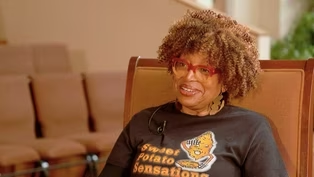
Today, we hear from Cassandra Thomas, the owner and founder of Sweet Potato Sensations Bakery and Restaurant.
She sat down with "Faith in Detroit" director Father William Danaher to talk about her professional journey.
(bright uplifting music) - What a delight to be with Cassandra Thomas, who is the owner and founder of Sweet Potato Sensations.
I am so blessed and grateful to be with you.
I have been watching your website and eating your food and just falling in love with the story that you tell.
And I also think the vision that you've brought to having a place where a sweet potato forward restaurant could be in Detroit and be a place where people can get to know all the versatility and the beauty and the wonder of that cuisine connected to the sweet potato.
And I there was something you said when we had dinner the other night.
You talked about your discovery of the sweet potato as being something that you came to late.
When you moved from Ohio and came to Detroit, you came and your husband liked sweet potatoes.
You didn't cook much with them.
And so you decided to do some cookies for him that were sweet potato based and he loved them and everybody else loved them.
And from there you started your wonderful bakery and then restaurant.
And I found that beautiful because you, most people, when they talk about the role that food plays in love, begin with the food.
The food was delicious and then they learned to love the person who made it.
You came to love the food through love itself.
It was your love for your husband.
- Yes.
- And you came to love the sweet potato.
Can you say a little bit more about that?
That the connection between love and food, maybe memory and God?
- Wow, that's a deep question.
(chuckles) Well, my husband was fanatical about sweet potatoes because he loves candied sweet potatoes.
And I was not a fan of candied sweet potatoes.
My parents always just roasted the sweet potatoes in the oven and ate them that way.
And that's what I grew up seeing.
Not the candied sweet potatoes because I'm not a big fan of sugary foods.
Sugar should be in a dessert, not a main entree, which was different for me.
I know a lot of people like, they go to restaurants, they eat coconut shrimp.
I mean, coconut shrimp looks beautiful, but just the sugar on the shrimp, I think coconut should be on a cake, not on my shrimp.
So it was kind of the same thing with my husband and these candied yams that he would say, but they're technically really candied sweet potatoes.
And he's reminded me constantly that his mother always made candied sweet potatoes.
And he could not understand why I was not making these for Thanksgiving and Christmas dinner.
And kind of under my breath I was, because I don't like them.
(Cassandra laughs) In order to keep the peace and because of love, I decided, well, you know what?
I'm going to make you a sweet potato cookie.
And I just said it just off the top of my head because I'm a cookie monster at heart.
I love cookies.
So I actually came up with a recipe for sweet potato cookies.
So when I made them, he's like, "Wow, these are, these are good," you know?
So we would make them for our family and friends when they would come up to visit us here in Detroit.
And people quite naturally would ask me, "Uh, well, can you send me the recipe?"
I said, "Oh, sure.
I'll send it to you."
Just never did, you know.
Wasn't that I was being mean-spirited or anything.
I just never though to send him the recipe.
So during the time when Famous Amos and Mrs.
Fields and all the cookie companies were the hot thing in the malls, you could go and get fresh baked cookies.
We decided, well, maybe our cookie might be marketable.
So we set up a table at a garage sale in a neighborhood and we had 125 bags of cookies.
We had surveys because we said nobody else may like these cookies other than ourselves.
And we found out from the garage sale that they liked the cookies.
And in less than three hours, all 125 bags were gone.
So we said, "Well, maybe we should start a business."
(Cassandra laughs) So that night, my husband, we went to sleep and he wakes up the next morning, "I got it, wifey.
Sweet Potato Sensations, the greatest taste in the nation."
And that's how it started.
- So that movement into entrepreneurship, it came out of this moment in which you realized that there was this larger community that wanted to have the products that you were able to develop.
But no one starts a business without a moment, I think, of not just inspiration, but faith and hope and love.
Particularly the kind of business that you run.
I was really interested to see that you featured Nikki's Teas, which is a cottage industry that went into larger supermarkets in the area.
Whole Foods carries Nikki's Teas.
- Yes.
- It started in the basement of a church in Detroit.
- Yes, it did.
- And for me the fact that you see that as your vision as an entrepreneur and as a restaurateur as a baker.
Can you say more about that vision and maybe connect it to your faith journey?
- The faith part of it has to do with, I had a pastor and his wife come to my shop one day when I had my first retail location.
And they gave me a scripture, "Do not despise small beginnings."
And when I think about it, you know, like a seed is very tiny and you put it in the ground and the roots grow and become the firm foundation for the seed and finally the seed will sprout.
So I wasn't really sure about this being a business.
It just kind of evolved.
And through faith in the Lord and trusting him, it was a journey really because I wasn't sure of myself.
And a lot of times when I would feel unsure I remember, on this one occasion, I was sitting back in my office.
I was in the shop alone.
This is when we had a smaller location across the street from where we are now.
And it was like a fall day, I want to say maybe October.
And a customer comes in and she comes to the counter and she takes off her gloves.
And she says, "I would like to buy a pie."
I said, "Oh, okay.
Thank you.
Can anything else I can do for you?"
She says, "I'll have a cheesecake and maybe some cookies," So I'm like, "Oh, okay.
Thank you."
So when I got finished with the transaction, "So anything else I can help you with?"
"No, I just want you to know that Jesus loves you."
I was blown away when she told me that.
I said, "Well, thank you."
(chuckles) So I've had experiences like this all throughout my time with Sweet Potato Sensations where I'm in the back having a pity party.
You know, I've had people tell me that I was wasting my college education.
My parents wasted their money sending me to school.
That when was I going to get a real job?
Oh, that's so cute you're baking cookies.
Very cynical, and when they're saying it, like it's just not a real thing.
So many times I would just doubt myself.
Like, okay, maybe I do need to get a real job.
I need to go out and apply to be a teacher or some, whatever it might be.
And every single time I would feel negative thoughts or doubts about things, the Lord would send someone.
That particular day, it was an individual.
I've gotten phone calls just out of the blue, an elder.
"Child, I just want to tell you, those are the best sweet potato pies I have eaten.
And I just want to tell you, don't you quit.
You just hang in there and keep on baking those pies.
If I was a little younger, I'd do the same thing myself."
I'm like, "Well, thank you, ma'am."
(laughs) So these situations would come up like that and I'd be like, "Okay, God, I'm not gonna quit.
I'm going to keep going, you know, even though I don't feel like I should."
But those are the kind of things that would happen every time I had those thoughts of quitting.
So I had to keep going.
And I did.
- Sweet potato is such a powerful dish, such a powerful supply to the food of the African American community.
- Yes.
- Is it true to say maybe that keeping that tradition going is a way of preserving community identity and memory and purpose in the face of often opposition.
Is that fair to say?
- I would think so.
There's certain dishes that are akin to our community, you know, collard greens and mac and cheese and candied sweet potatoes.
And the sweet potato pie, it's really interesting.
It's kind of a... Everybody has their own version of sweet potato pie.
And of course, I don't argue with any customers that, well, their mother made it this way.
My grandmother made it this way.
My nana made it this way.
However it was made, it is the best.
That's what I tell them.
Because it's almost like you get real personal about these sweet potato pies.
And they tell me that theirs is better.
I say, "Yes, it is."
I don't argue with them.
The Lord told me that, tell them theirs is the best because it is.
Because however your family did it, that's the best because that's what you grew up knowing and seeing.
So I said, when they don't feel like making it, then come see us and we'll make one for you.
So it kind of helps with that situation.
The sweet potato pie is one of the dishes that we take to heart in the African American community.
- That will do it for us this week.
You can find out more about our guests at americanblackjournal.org and you can connect with us anytime on social media.
Take care and we'll see you next time.
(upbeat music) - [Narrator] This program is made possible in part by: Lilly Endowment and Christ Church Cranbrook.
- [Narrator] Across our Masco family of companies, our goal is to deliver better living possibilities and make positive changes in the neighborhoods where we live, work, and do business.
Masco, a Michigan company since 1929.
Support also provided by the Cynthia and Edsel Ford Fund for Journalism at Detroit PBS.
- [Narrator] The DTE Foundation is a proud sponsor of Detroit PBS.
Through our giving, we are committed to meeting the needs of the communities we serve statewide to help ensure a bright and thriving future for all.
Learn more at dtefoundation.com.
- [Narrator] Also brought to you by Nissan Foundation and viewers like you.
Thank you.
(cheerful piano music)
 New
NewHow Venture 313 is investing in Black tech entrepreneurs in Detroit
Video has Closed Captions
Clip: S54 Ep31 | 12m 28s | The Detroit-based initiative is helping African American-owned tech companies tackle barriers. (12m 28s)
 New
New"Sweet Potato Sensations" owner Cassandra Thomas discusses faith and her professional journey
Video has Closed Captions
Clip: S54 Ep31 | 11m 25s | A local restaurant owner talks about the connection between faith and food. (11m 25s)
Providing Support for PBS.org
Learn Moreabout PBS online sponsorship New Episode
- News and Public Affairs

Top journalists deliver compelling original analysis of the hour's headlines.
 New Episode
- News and Public Affairs

Today's top journalists discuss Washington's current political events and public affairs.


 New Episode
 New Episode
 New Episode
 New Episode
 New Episode
 New Episode
 New Episode
Support for PBS provided by:
American Black Journal is a local public television program presented by Detroit PBS