
Evan Shapiro and Geoff Bennett on the future of media
Clip: 4/13/2026 | 3m 39sVideo has Closed Captions
Evan Shapiro and Geoff Bennett explore the future of media on 'Settle In'
The media industry has been navigating substantial turmoil in recent years. On our PBS news podcast, “Settle In,” Geoff Bennett explored this upheaval with Evan Shapiro. He’s an award-winning producer who now writes about the industry for his Substack, “Media War and Peace.”
Problems playing video? | Closed Captioning Feedback
Problems playing video? | Closed Captioning Feedback
Major corporate funding for the PBS News Hour is provided by BDO, BNSF, Consumer Cellular, American Cruise Lines, and Raymond James. Funding for the PBS NewsHour Weekend is provided by...
Evan Shapiro and Geoff Bennett on the future of media
Clip: 4/13/2026 | 3m 39sVideo has Closed Captions
The media industry has been navigating substantial turmoil in recent years. On our PBS news podcast, “Settle In,” Geoff Bennett explored this upheaval with Evan Shapiro. He’s an award-winning producer who now writes about the industry for his Substack, “Media War and Peace.”
Problems playing video? | Closed Captioning Feedback
How to Watch PBS News Hour
PBS News Hour is available to stream on pbs.org and the free PBS App, available on iPhone, Apple TV, Android TV, Android smartphones, Amazon Fire TV, Amazon Fire Tablet, Roku, Samsung Smart TV, LG TV, and Vizio.
Providing Support for PBS.org
Learn Moreabout PBS online sponsorshipAMNA NAWAZ: Well, the media industry has been navigating substantial turmoil in recent years, from big mergers to layoffs to accusations of government censorship.
On a recent episode of our PBS News podcast "Settle In," Geoff Bennett explored all this upheaval with Evan Shapiro.
He's an award-winning producer who now writes about the industry for his Substack Media War & Peace.
Here now is a clip of that conversation.
EVAN SHAPIRO, Media War & Peace: I do think we have this perception that very few people control the media.
That is less and less true on an ongoing basis, especially when you consider that YouTube is now the biggest channel on TV sets in the U.S.
and everyone says, well, they're the big tech.
They control so much voice.
In reality, YouTube is 4.6 million different channels.
And a million of them control a lot of the voice there, but that's still a million channels.
So, in my mind, fragmentation is now the most important factor in media.
I like to say that, when I was rising up in media, it was a lot easier because your competition was a few other channels.
Now your competition is everybody, all seven billion people on the planet Earth with a smartphone.
The good news is that, back when I was coming up in media, there were only a few buyers of the stuff that you would make.
Now there are seven billion, eight billion buyers of the media you make.
So the control has shifted from these ivory towers, who think they're still in charge, to the consumer themselves, who really do control the media in their system settings whenever they touch that piece of glass that they pick up first thing in the morning.
GEOFF BENNETT: You recently gave a talk called "The Year of Change or Die," which is pretty -- pretty stark framing.
What did you mean by that?
EVAN SHAPIRO: So this is the year that the combination of the creator economy and mainstream media will really intersect in a way that they hadn't before.
And you see this in Procter & Gamble producing a microsoap for TikTok and Instagram.
You see this in MrBeast being on Amazon, Ms.
Rachel being on Netflix.
And so the folks who operate their businesses by the vanity metrics of eras past, they're going to find it more and more difficult to succeed.
The best example I will give you is, last year, all premium streamers on the face of the Earth - - so these are the paid streaming platforms like Amazon Prime and Netflix and Disney+ and Hulu and the rest -- they gained 175 million new subscribers.
Hooray.
They also lost 158 million subscribers.
The retention has been -- it's a third of what it was five years ago.
It's half of what it was four years ago.
They're going to get to a zero retention in the next couple of years, and then suddenly, premium streaming, this thing that was going to save television, right, is going to be in the same place cable is, losing subscribers, revenues shrinking, instead of growing.
And, in reality, at the same time, these social media platforms, social video, things like YouTube, TikTok, Instagram, Snap, these are now where people under the age of 50, not under 30, not under 20, under the age of 50, they're spending much more time there than they are on other platforms.
The fastest growing segment of viewers of YouTube on television are people 55-plus.
AMNA NAWAZ: And you can watch that full conversation and all episodes of "Settle In" on YouTube or wherever you get your podcasts.

How the U.S. blockade could pressure the Iranian regime
Video has Closed Captions
Mideast experts discuss how the U.S. blockade could pressure the Iranian regime (8m 58s)

How the vote to oust Orbán could have global implications
Video has Closed Captions
How Hungary’s vote to oust Viktor Orbán could have global implications (10m 8s)

News Wrap: Judge dismisses Trump's lawsuit against WSJ
Video has Closed Captions
News Wrap: Judge dismisses Trump's lawsuit against WSJ for story on Epstein ties (3m 13s)
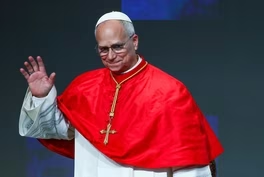
Pope Leo vows to continue speaking out after Trump clash
Video has Closed Captions
Trump clashes with Pope Leo, who vows to continue speaking out against war (4m 59s)
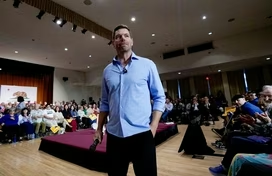
Rep. Swalwell resigning after sexual assault accusations
Video has Closed Captions
Swalwell resigning from Congress after sexual assault accusations (7m 52s)

Tamara Keith and Jasmine Wright on Trump, Pope Leo feud
Video has Closed Captions
Tamara Keith and Jasmine Wright on Trump's feud with Pope Leo (8m 48s)

U.S. begins naval blockade after Iran peace talks fail
Video has Closed Captions
U.S. begins Strait of Hormuz naval blockade after Iran peace talks fail (5m 15s)
Providing Support for PBS.org
Learn Moreabout PBS online sponsorship
- News and Public Affairs

Today's top journalists discuss Washington's current political events and public affairs.

- News and Public Affairs

FRONTLINE is investigative journalism that questions, explains and changes our world.












Support for PBS provided by:
Major corporate funding for the PBS News Hour is provided by BDO, BNSF, Consumer Cellular, American Cruise Lines, and Raymond James. Funding for the PBS NewsHour Weekend is provided by...