
April 29, 2026 - PBS News Hour full episode
4/29/2026 | 57m 46sVideo has Closed Captions
April 29, 2026 - PBS News Hour full episode
April 29, 2026 - PBS News Hour full episode
Problems playing video? | Closed Captioning Feedback
Problems playing video? | Closed Captioning Feedback
Major corporate funding for the PBS News Hour is provided by BDO, BNSF, Consumer Cellular, American Cruise Lines, and Raymond James. Funding for the PBS NewsHour Weekend is provided by...
April 29, 2026 - PBS News Hour full episode
4/29/2026 | 57m 46sVideo has Closed Captions
April 29, 2026 - PBS News Hour full episode
Problems playing video? | Closed Captioning Feedback
How to Watch PBS News Hour
PBS News Hour is available to stream on pbs.org and the free PBS App, available on iPhone, Apple TV, Android TV, Android smartphones, Amazon Fire TV, Amazon Fire Tablet, Roku, Samsung Smart TV, LG TV, and Vizio.
Providing Support for PBS.org
Learn Moreabout PBS online sponsorshipGEOFF BENNETT: Good evening.
I'm Geoff Bennett.
AMNA NAWAZ: And I'm Amna Nawaz.
On the "NewsHour" tonight: A Supreme Court decision weakens the Voting Rights Act.
How striking down a Louisiana map could lead to the elimination of Black and Latino majority districts nationwide.
GEOFF BENNETT: Defense Secretary Pete Hegseth and other Pentagon officials face congressional scrutiny for the first time since the start of the Iran war.
AMNA NAWAZ: And Judy Woodruff examines how Americans are celebrating the nation's 250th anniversary in their own local communities.
MARIA MONCLOVA, Tax Day Carnival Attendee: Right now, with everything happening, I think it's very important for a community to celebrate what the country was based on, which is immigrants, which is diversity.
(BREAK) AMNA NAWAZ: Welcome to the "News Hour."
The U.S.
Supreme Court today struck down one of Louisiana's majority-Black congressional districts, a decision that weakens key protections under the Voting Rights Act.
In a 6-3 ruling, the court's conservative majority found that Louisiana's Sixth District, which links Black communities across the state, relied too heavily on race in its design.
GEOFF BENNETT: Writing for the majority, Justice Samuel Alito called the map an unconstitutional gerrymander.
The decision could open the door to broader legal challenges over majority Black and Latino districts across the country and give states new latitude to redraw maps in ways that could shift the balance of political power.
Louisiana Democratic Congressman Troy Carter said the impact of the ruling will extend far beyond his state.
REP.
TROY CARTER (D-LA): This is about our democracy.
And I implore everyone who's out there to recognize that, if you care about justice, freedom, and fair elections, you should be as upset as we are.
GEOFF BENNETT: We are joined now by Amy Howe, "News Hour" Supreme Court analyst and co-founder of SCOTUSblog, and Amy Walter of The Cook Political Report With Amy Walter.
It's great to have the both of you here.
So, Amy Howe, we will start with you.
The Voting Rights Act of 1965, long been considered a cornerstone of protections against racial discrimination in voting past, during the height of the civil rights movement, expanded by Congress thereafter, given that history, help us understand exactly what the court ruled today.
AMY HOWE: So the court did two things.
First, as the introduction suggested, it struck down this map that Louisiana drew in 2024 that created a second majority-Black district in Louisiana.
And it had done that in response to a court ruling in a case that had been brought by Black voters arguing that Louisiana had violated the Voting Rights Act when it drew a map in 2022, because that map only had one majority-Black district.
And those voters said that Louisiana had diluted their votes, that they had cracked and packed, the voting rights terminology goes, Black voters.
And so it struck that -- it struck the 2024 map down, which was intended to address the Voting Rights Act violation.
And then in the process of getting to that conclusion, the court articulated a new test or, as Justice Samuel Alito put it, writing for the majority, updated its old test for determining whether or not a violation of Section 2 of the Voting Rights Act, which prohibits discrimination on the basis of race in voting, exists.
And it said, if plaintiffs want to allege that there is a violation of Section 2, they need to show that there is intentional discrimination on behalf of the state when it's drawing these kinds of maps.
GEOFF BENNETT: And, Amy Walter, what's the political impact of all of this?
We know that Texas and Virginia have implemented new highly contested congressional maps.
Florida, for instance, just passed a new congressional map today that could net them up to four more Republican seats.
What comes next?
AMY WALTER, The Cook Political Report: Yes, I think there's the short term and then the long term.
In the short term, the timing of this decision is a little bit awkward for the 2026 midterms.
Most states have already closed their candidate filings, so it's not possible for candidates to just suddenly decide that they want to run.
So if states are going to reopen redistricting, they're going to have to move that deadline and, in some cases, maybe even move the primary.
So the appetite from legislators and governors, we don't quite know where that is at this point.
Right now, it seems like there are a couple of states that may be open to doing such a thing, either moving their deadlines and bringing the legislature back.
A state like Tennessee is being talked about a lot, which could net Republicans one seat.
But I think the bigger picture here is that the state of the 2026 midterms unlikely to be as impacted by this decision as the 2028 election will be.
There's little doubt that this opens the door now for governors and legislators in Republican states in the South, like Mississippi and Alabama, I mentioned South Carolina, to go in, redraw maps that would take those what are now majority-Black democratic districts and basically draw maps that have entirely Republican delegations.
GEOFF BENNETT: Our team earlier today spoke with Janai Nelson, president of the NAACP Legal Defense Fund.
That organization argued in favor of keeping the current maps.
And she said that the ruling today upends voting protections entirely.
JANAI NELSON, President and Director-Counsel, NAACP Legal Defense Fund: I'm horrified that our Supreme Court has trampled not only on the rights of Congress to enact legislation pursuant to its powers under the Constitution, not only trampling on the principle of adhering to its own precedent, which would have dictated that we should win outright in this case, but also trampling on the right to vote as severely as it did today.
GEOFF BENNETT: And Nelson also said that racial groups, Black voters, Latino voters, the growing Asian population in this country, will have no path to challenge what they see as discriminatory maps.
There's no path to accountability.
And, Amy Howe, technically, the Supreme Court kept Section 2 in place.
Is that meaningful or just cover?
AMY HOWE: So, Justice Clarence Thomas, joined by Justice Neil Gorsuch, wrote a concurring opinion, and he would have struck down Section 2 of the Voting Rights Act altogether.
But, as you say, the rest of the justices said that Section 2 is still in place.
Justice Elena Kagan wrote the dissenting opinion in the case.
She was joined by the court's other two Democratic appointees, Justice Sonia Sotomayor and Justice Ketanji Brown Jackson.
And Justice Kagan actually read her dissent from the bench, which is a sign of how strongly she disagreed with the court's decision today.
And she suggested that the court had really eviscerated the Voting Rights Act Section 2, even if it theoretically left it in place.
And what she said was, under the standard that the court announced today, where plaintiffs have to show essentially intentional discrimination on behalf of the state, she said that's going to be basically impossible for plaintiffs to show going forward.
So I think it is very fair to say that it weakens it.
GEOFF BENNETT: And we should explain Section 2 of the Voting Rights Act prohibits voting practices that discriminate on the basis of race.
Our team also spoke with the conservative legal scholar Hans Von Spakovsky, who agrees with the court's decision today.
He says that we live in a very different world than we did when the Voting Rights Act was initially enacted.
HANS VON SPAKOVSKY, Former Federal Election Commissioner: Conditions are just so changed today.
You have viable -- two viable political parties.
You have many instances where, for example, Black Americans have been elected to Congress, not in these majority-Black districts, but in white districts.
Why?
Because of the party they're in.
And that again brings up that party affiliation is the probably most important factor in whether people get elected or not.
GEOFF BENNETT: What do you make of that?
AMY WALTER: The argument is that you can't draw a partisan map, especially when it comes to Black voters, without drawing a racially gerrymandered map.
As long as Black voters are voting overwhelmingly, 90 percent, for Democrats, the two really are basically one in the same.
But it is true, yes, there are Black lawmakers in this country that represent districts that are not majority-Black, but not in the South.
And so what you're going to see in places like Alabama or South Carolina or Georgia, which have significant Black populations, it's not going to -- the representation from those states is unlikely to come from an African-American member of Congress.
The other thing I want to point out too is Democrats also have their own challenges with this as well.
They are arguing that they will go and try to do their own redraws, which may require them to go into majority -- in Democratic states, into majority-minority districts, and diffuse those voters in order to drop more Democratic seats.
That could also put other Democratic lawmakers in blue states who happen to be African-American or Latino in a more difficult position to win.
GEOFF BENNETT: Amy Howe, in the time that remains, I want to ask you about the oral arguments today, because the Supreme Court heard one of the most consequential immigration cases of this term.
It's a challenge to the Trump administration's efforts to strip temporary protected status from tens of thousands of Syrian and Haitian nationals living in the U.S.
What were the takeaways?
AMY HOWE: So, it was actually a case in which the justices were somewhat difficult to read.
Some of the justices didn't ask that many questions.
This was a case going in, in which we sort of expected that the conservative justices would be likely to be sympathetic to the Trump administration.
A lot of the time was spent discussing whether or not these are the kinds of claims that courts can review at all.
The Trump administration is arguing that the statute that created this program contains a provision that bars courts from weighing in at all.
So the three Democratic appointees spent a lot of time in particular on that.
I think that the question of whether or not courts can weigh in and whether or not the challengers could prevail if they can will ultimately depend on the chief justice and Justice Amy Coney Barrett.
And this is one in which we are not likely to learn the answer, I imagine, until probably late June or early July.
GEOFF BENNETT: Amy Howe, Amy Walter, thank you both.
We appreciate it.
AMY HOWE: You're welcome.
AMY WALTER: Thank you.
AMNA NAWAZ: Today, for the first time since the U.S.
went to war with Iran, Defense Secretary Pete Hegseth faced sharp questions from Congress.
During the hearing, the Pentagon revealed that the war so far has cost $25 billion.
The fighting is on hold, but the military maintains its blockade of the Strait of Hormuz.
And "PBS News Hour" has learned one of the aircraft carriers currently in the region, the USS Gerald R. Ford, will soon head home after a record-setting 10 months at sea.
Nick Schifrin reports on a contentious hearing and a partisan divide over the war.
NICK SCHIFRIN: After two months of fighting in the Middle East, the theater of war today was Capitol Hill and a partisan fight over Iran.
PETE HEGSETH, U.S.
Defense Secretary: Based on the intel.
MAN: Stop.
Stop.
Reclaiming my time.
PETE HEGSETH: Because you yell doesn't make you right.
NICK SCHIFRIN: The U.S.
and Israel says its campaign has eliminated more than half of Iran's missiles and drones, much of its defense industrial base, its entire conventional navy and air force, and has now become a fight over Iran's choke hold over the Strait of Hormuz.
But Secretary Pete Hegseth said today the threat of Iran pales in comparison to what he called Democratic defeatism.
PETE HEGSETH: The biggest challenge, the biggest adversary we face at this point are the reckless, feckless and defeatist words of congressional Democrats and some Republicans.
NICK SCHIFRIN: The secretary and this House Armed Services Committee haven't always been that political.
But, today, even some previously skeptical Republicans piled on the praise.
REP.
NANCY MACE (R-SC): Everything I have seen, you have surpassed all of my expectations and I just want to say thank you from the bottom of my heart.
NICK SCHIFRIN: And Democrats voiced the most criticism.
REP.
JOHN GARAMENDI (D-CA): The president has got himself in America stuck in a quagmire of another war in the Middle East.
He's desperately trying to extricate himself from his own mistakes.
PETE HEGSETH: You call it a quagmire, handing propaganda to our enemies?
Shame on you for that statement.
And statements like that are reckless to our troops.
NICK SCHIFRIN: Early on, the Pentagon's chief financial officer disclosed for the first time the war's $25 billion cost.
REP.
ADAM SMITH (D-WA): So you're saying the full cost at this point is $25 billion?
JAY HURST, Pentagon Chief Financial Officer: Yes, that's our estimate for the cost.
REP.
ADAM SMITH: OK, interesting, because we -- I'm glad you answered that question, because we have been asking for a hell of a long time and no one's given us the number.
NICK SCHIFRIN: Democrats argue that number misses the war's true cost.
REP.
RO KHANNA (D-CA): Do you know how much it will cost Americans in terms of their increased cost in gas and food over the next year because of the Iran war?
PETE HEGSETH: I would simply ask you what the cost is of an Iranian nuclear bomb.
REP.
RO KHANNA: I'm going to give you that opportunity.
PETE HEGSETH: I would simply ask you what the -- you're playing gotcha questions about domestic things.
I'm not... REP.
RO KHANNA: No, it's not.
You're asking -- you're saying it's a gotcha question to ask what it's going to be in terms of the increased cost of gas?
PETE HEGSETH: Why won't you answer what it costs to prevent Iran from getting a nuclear bomb?
REP.
RO KHANNA: I give you that, sir.
You don't know what we're paying in terms of gas.
You don't know what we're paying in terms of food.
Your $25 billion number is totally off.
It's the incompetence.
It's the incompetence.
NICK SCHIFRIN: One moment of Republican and Democratic agreement: REP.
DON BACON (R-NE): I share a bipartisan concern of the firings that we have seen at the Pentagon.
NICK SCHIFRIN: A deep concern about the firings of dozens of senior military and civilian leaders, including most recently Navy Secretary John Phelan and Chief of Staff of the Army General Randy George.
REP.
DON BACON: Now, I would just point out it may be constitutionally right.
You have the constitutional right to do these things, but it doesn't make it right or wise.
PETE HEGSETH: It's very difficult to change the culture of a department that has been destroyed by the wrong perspectives with the same officers that were there.
REP.
CHRISSY HOULAHAN (D-PA): So you think General George destroyed a culture?
PETE HEGSETH: There are many -- we have gotten rid of many general officers in this administration, because we need new leadership.
REP.
CHRISSY HOULAHAN: You have no answer, sir.
You have no way of explaining why you fired one of the most decorated and remarkable men who's ever served the nation.
PETE HEGSETH: We needed new leadership.
That's my answer.
REP.
CHRISSY HOULAHAN: And so your answer is a very immature way of responding to my request.
NICK SCHIFRIN: Today's hearing was actually called to discuss the administration's record $1.45 trillion budget request, which goes well beyond replenishing munitions spent in Iran to build much-needed drones, missile defense and increased boat building.
The budget represents a 40 percent increase and won't survive at that number, but would help the U.S.
catch up to what committee Chairman Alabama Republican Mike Rogers called China's People's Liberation Army's growing advantage.
REP.
MIKE ROGERS (R-AL): China continues to invest heavily in the PLA's military modernization, announcing another 7 percent increase in defense spending this year.
As a result, they are spending more of their GDP on defense than we are.
NICK SCHIFRIN: Chairman of the Joint Chiefs of Staff General Dan Caine called the request a much-needed long-term investment.
GEN.
DAN CAINE, Chairman, Joint Chiefs of Staff: As we look at the character of warfare changing very, very fast, what's layered in to this budget by our civilian leaders will allow us to start getting ahead of where technology is evolving.
NICK SCHIFRIN: But today in the Middle East, it is not advanced technology helping determine the war's fate.
Iran is using the threat of mines and drones to keep a choke hold over the Strait of Hormuz.
Iran recently offered to open the strait if the U.S.
lifted its own blockade and paused any discussion of Iranian nuclear limits, an offer that President Trump today rejected.
DONALD TRUMP, President of the United States: At this moment, there will never be a deal unless they agree that there will be no nuclear weapons.
NICK SCHIFRIN: Instead, U.S.
officials say they will maintain the blockade, enforced just yesterday by Marines on a commercial tanker, and keep up maximum economic pressure, hoping Iran loosens its demands.
Until then, tankers remain at a standstill and the war's diplomacy in a standoff.
For the "PBS News Hour," I'm Nick Schifrin.
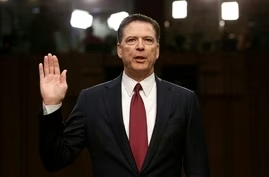
AMNA NAWAZ: In the day's other headlines: Former FBI Director James Comey appeared in a Virginia court today on charges that he threatened President Trump's life.
During the brief closed-door hearing, Comey did not enter a plea deal, but his lawyers said they plan to argue his prosecution is vindictive and selective.
Comey faces two criminal charges related to a photo he posted online last year of seashells spelling out the numbers 8647, 86 being common slang for getting rid of something or someone and Trump being the 47th president.
Comey later removed the post.
He's denied any wrongdoing.
In California today, Elon Musk was back on the stand for a second day of testimony, part of his lawsuit against OpenAI and its co-founder, Sam Altman.
During tense, at times combative, cross-examination, Musk said he was a fool for helping to fund OpenAI in its early days.
Musk said he was tricked into believing the ChatGPT creator would remain a nonprofit, instead of the $800 billion giant it is today.
He split with the company in 2018, and is seeking more than $150 billion in damages.
A lawyer for OpenAI says Musk only filed the lawsuit because he -- quote -- "didn't get his way."
A cleanup is under way in Northern Texas today after intense storms injured at least five people and left a path of destruction.
Aerial footage from this morning shows demolished homes and toppled trees in the small city of Mineral Wells about an hour west of Fort Worth.
The storm brought hail and at least one confirmed tornado that scattered debris and crushed roofs.
Local officials told reporters today a curfew is in place for a second night as they start to rebuild.
RYAN DUNN, Mineral Wells, Texas, Fire Chief: One thing that we're really extremely good at is caring for each other.
So, we're here.
We're going to be here until this is all cleaned up.
And then we will rebuild it, and we're going to make it look better than it was.
AMNA NAWAZ: The Texas governor issued a disaster declaration yesterday for three counties affected by the storms.
Forecasters say more severe weather is expected to hit the area tonight.
Prosecutors released new details today about the suspect charged with attempting to kill President Trump at the White House Correspondents' Dinner.
They say Cole Allen took this selfie on Saturday night in his hotel room dressed in black pants and a red tie.
A closer image shows his various weapons.
It was part of a court filing today laying out the government's case to deny bail for the 31-year-old.
Minutes after the photo was taken, Allen was seen charging past ballroom security.
He was quickly captured and faces one count of attempting to assassinate the president, plus other charges.
A hearing is set for tomorrow.
The Justice Department is charging 10 current and former Mexican officials with conspiring with a powerful cartel to import drugs into the U.S.
Among those named in today's indictment is Sinaloa State Governor Ruben Rocha.
He's accused of protecting Sinaloa cartel members in exchange for bribes and political support, which he denies.
Rocha is a member of the political party led by President Claudia Sheinbaum.
She has said her government is cracking down on corruption, though President Trump has insisted that more needs to be done.
None of those charged today are currently in custody.
King Charles and Queen Camilla were in New York today as part of their ongoing visit to the U.S.
The couple laid a wreath at the National 9/11 Memorial and met with victims' families, among other events.
It's part of a four-day visit to mark the 250th anniversary of America's independence from Great Britain and it comes at a time of strained relations between the two nations.
Last night, King Charles capped off a day of pageantry and diplomacy with a state dinner at the White House.
In his own remarks, President Trump revealed details about a private conversation he had with the king about the war in Iran.
DONALD TRUMP, President of the United States: I think we have militarily defeated that particular opponent, and we're never going to let that opponent ever -- Charles agrees with me even more than I do.
We're never going to let that opponent have a nuclear weapon.
They know that and they have known it right now very powerfully.
(APPLAUSE) AMNA NAWAZ: By convention, the British monarch is meant to be politically neutral and closed-door conversations are usually kept private.
Buckingham Palace responded today by saying the king is -- quote -- "mindful" of his government's position on -- quote -- "the prevention of nuclear proliferation."
Police in the U.K.
are treating the stabbing of two Jewish men today as an act of terrorism.
The attack happened in a predominantly Jewish area of North London.
The two victims were taken to a hospital and are in stable condition.
A 45-year-old man was arrested on suspicion of attempted murder.
Police say he has a history of serious violence and mental health issues.
Counterterrorism officials are looking into possible links to recent arson attacks on synagogues and other Jewish sites in the city.
On Wall Street today, stocks ended mixed after the Fed held interest rates steady.
The Dow Jones industrial average fell 280 points, or about half-a-percent.
The Nasdaq managed a slight gain of less than 10 points.
The S&P 500 ended a touch lower on the day.
Still to come on the "News Hour": what's still stopping Congress from agreeing on Homeland Security funding; Jerome Powell announces he will stay on the Federal Reserve's board after stepping down as chair; we speak with a business owner trying to get tariff refunds; and what it takes to create the perfect fields for the upcoming World Cup.
GEOFF BENNETT: Well, it has been a busy week across Washington.
And it's also a critical one on Capitol Hill.
After weeks of internal clashes, House Republicans are trying and struggling to move forward on more on four major pieces of legislation.
Those include extending U.S.
surveillance authorities, ending the shutdown at the Department of Homeland Security and advancing key farm policy, all while managing deep divisions within their own conference.
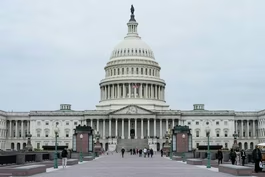
Our congressional correspondent, Lisa Desjardins, joins us now to help us make sense of all of this.
So, Lisa, let's start with this DHS shutdown, which has been going on for a record two months.
What's the latest?
LISA DESJARDINS: It does not look like that shutdown will end this week.
And let me talk about why.
Well, first of all, I want to remind viewers that the Senate has already passed twice bills that would find most of DHS.
They would carve out ICE and Border Patrol for a separate, more complicated process.
So the Senate has taken that action.
It was passed in a bipartisan manner by Democrats and - - senators and Republicans together.
But Speaker Mike Johnson and his House Republicans have now made it clear that they will not accept that bill.
They're going to write their own way to fund the DHS issue.
And they have a problem because the Senate bill would technically zero out DHS funding for this year.
However, I want to remind our viewers that last year DHS got a special appropriation when you -- of One Big Beautiful Bill, tens of billions of dollars that would fund it for years.
So the idea of zeroing out this year's money really may not affect it too much.
So where does all that leave us?
The House and Senate fighting each other and something that could end up taking days, if not weeks.
But, reminder, there are tens of thousands of employees, including TSA employees, who will not be paid after this Friday.
And that could build pressure.
GEOFF BENNETT: Meantime, you have got U.S.
intelligence agencies saying that one of their most powerful surveillance tools is set to expire.
And there are also conservatives who say, OK, but we want more protections.
Tell us about that.
This is FISA, the Foreign Intelligence Surveillance Act, Section 702.
This allows the U.S.
to spy and have wiretaps on foreign actors.
There are concerns from conservatives, especially some of them, about protections for American data, getting caught up on that.
What they wanted today was warrants, force for warrants on American data.
They didn't get that.
They got some reforms in a deal in the House with Speaker Johnson.
But this expires tomorrow.
And what they have put in the bill in the House is something that would ban the Federal Reserve from issuing what's called a Central Bank digital currency.
That's also a concern about digital overreach or government overreach.
This is all swirled together in a way that means the House has passed a different or is looking at -- has just passed a different FISA reauthorization than the Senate.
I know that's confusing, but what it means is that tomorrow's deadline for FISA, they won't be able to pass a long-term reauthorization.
They're hoping Senator John Thune has just said to do something short-term probably with just hours left.
GEOFF BENNETT: And then you also have the farm bill, which has all sorts of provisions in it.
That's held up in the House?
LISA DESJARDINS: Yes.
And, this, we're watching very closely tonight.
Speaker Johnson made a deal with conservatives to put off a vote on this.
There are two issues, one, pesticides, that House Republicans are divided over, and the other over whether to expand ethanol sales in this country E15.
He said he would put off these votes for weeks.
He's changed his mind in the last couple of hours.
And there is great internal strife, to put it lightly over this.
So we will watch the farm bill closely as well.
GEOFF BENNETT: It's all happening in real time.
Lisa Desjardins, thank you.
LISA DESJARDINS: You're welcome.
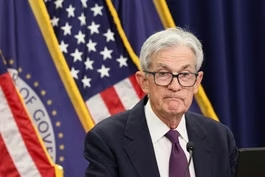
AMNA NAWAZ: The Federal Reserve held raid study today, as expected, but it was a significant day for the Central Bank as it transitions to new leadership.
Kevin Warsh, President Trump's pick for Fed chair, was confirmed in a Senate committee vote, clearing the way for a full Senate vote in mid-May.
The Central Bank's current head, Jerome Powell, stated that he will step aside when his term is chair ends May, 15 but he will remain on the Federal Reserve Board of Governors.
Powell made clear today he was staying on to make sure that a probe into the Fed headquarters of renovations launched by the Trump administration is -- quote -- "well and truly over."
He also addressed the persistent attacks from the president himself.
JEROME POWELL, Federal Reserve Chairman: I have never suggested that such a verbal criticism is a problem, and neither has anyone else here.
But these legal actions by the administration are unprecedented in our 113-year history, and there are ongoing threats of additional such actions.
I worry that these attacks are battering the institution and putting at risk the thing that really matters to the public, which is the ability to conduct monetary policy without taking into consideration political factors.
AMNA NAWAZ: David Wessel of the Brookings Institution is tracking all of this as usual and joins me now.
It's good to see you.
DAVID WESSEL, Brookings Institution: Good to see you.
AMNA NAWAZ: So Powell's decision to stay on the Federal Reserve Board of Governors even after his chairmanship ends, how unusual is that?
DAVID WESSEL: It's unusual.
The last time it happened was in 1948, when Marriner Eccles' term as chairman was up.
But at that time, President Truman asked Eccles to stay on the board.
That's the only time this happened before.
It's pretty unusual.
And, as you said, it's because he says, I'm staying until this criminal investigation of me and the building ends.
You want me off the Federal Reserve Board, finish the investigation.
AMNA NAWAZ: So what is your sense of when he might feel satisfied that things -- as he puts it, things have calmed down, that he can step down?
DAVID WESSEL: Well, the U.S.
attorney has said that she's waiting for a report by the Fed's inspector general, which actually is something that Powell himself initiated several months ago.
My guess is that, for the next few months, Powell will stay there.
He says he's going to keep a low profile, and that some time later this year, the I.G.
will report, and the I.G.
will say that it wasn't well managed, but there were no criminal charges or no criminal wrongdoing.
And, at that point, Powell will go.
That's my guess.
AMNA NAWAZ: So let's turn now to his likely successor here, Kevin Warsh.
He cleared the Senate Banking Committee vote today.
He did face a lot of questions in his confirmation hearings about his independence from President Trump if he's fully confirmed.
Is there any reason to believe that he won't make it through a full confirmation vote in the Senate?
DAVID WESSEL: No, the problem was in the Senate Banking Committee.
It was a very partisan vote, though.
That's unusual.
Usually, Fed chairs are more bipartisan.
It was 13-11 Republicans and Democrats.
He's almost certain to be confirmed, and I suspect he will be sworn in before May 15, which is the day that Jay Powell's term as chair ends.
AMNA NAWAZ: And he insisted that he will maintain independence from President Trump when he was asked about this.
But he also talked about regime change, about big changes in the way the Fed communicates with the public.
What would you expect to see from him as Fed chair?
DAVID WESSEL: Well, he does insist that he's going to be independent.
But the question is not what he says, but what he will do and how he will react if the Fed doesn't rate lower interest rates, as President Trump asks, how he will respond.
I don't know what regime change means.
It might be some changes in the Fed's communication, in the forecast they make, in how he does the press conferences.
My guess is going to be very slow change.
I don't think he's going to come down and turn the place inside out.
AMNA NAWAZ: But the chair doesn't rule the Fed, right?
All the -- it can move the board, but all the board members have to vote on the changes and the policy.
Based on the current board makeup, are there people there who will disagree with Warsh, who would push back on some of these changes?
DAVID WESSEL: Absolutely.
And, remember, monetary policy is made by a committee, the seven governors in Washington and five of the 12 Reserve bank presidents out in the region.
And at today's meeting, three of those presidents basically fired a shot across Kevin Warsh's bow.
They said they did not want a statement that implied that the Fed's next move is to lower interest rates.
So he's not going to be able to do anything on interest rates very quickly, because so many of the policy members are against him.
And he still has to deal on major changes in Fed communications and stuff.
He will need a consensus of the board.
So I suspect this will be a slow process.
It will be interesting how he deals with a bunch of people who he's been accusing of screwing up for the last 15 years since he left the Fed.
There might be some interesting conversations, but he's a pretty smooth guy.
AMNA NAWAZ: There's also the ongoing case against Fed Board member Governor Lisa Cook.
AMNA NAWAZ: The Trump administration has accused her of mortgage fraud.
She's been fighting that and her dismissal.
It's before the Supreme Court right now.
If she is ousted, how does that change the makeup of the board or President Trump's influence?
DAVID WESSEL: Well, there's seven members of the Federal Reserve Board and there are three who are Trump appointees.
One will leave when Kevin Warsh gets there.
If anybody goes, Lisa Cook, Jay Powell, Michael Barr, if anything goes, then the Trump appointees will have a majority and it will be easier for them to do something if they all agree on what they want to do.
And I think that's what the president wants.
AMNA NAWAZ: We will wait and watch and see.
David Wessel, always good to see you.
Thank you so much.
DAVID WESSEL: You're welcome.
GEOFF BENNETT: Among the many uncertainties clouding the U.S.
economic picture are tariffs, both the prospect of new ones and upcoming refunds from recent tariffs deemed illegal.
And there are a number of questions for businesses and consumers alike.
Our Stephanie Sy has more.
STEPHANIE SY: In February, the Supreme Court struck down the sweeping tariffs imposed by President Trump under the International Emergency Economic Powers Act.
Now businesses are scrambling to get their money back.
Last week, U.S.
Customs and Border Protection started accepting refund claims for $166 billion in tariffs collected over the past year, including from companies such as Basic Fun!, which sells toys familiar to many of us Tonka trucks, Care Bears and Lite-Brite The CEO, Jay Foreman, joins me now.
Jay, great to have you back on the "News Hour."
So, how much money are you owed?
And tell us what the process has been like to claim the refund.
JAY FOREMAN, CEO, Basic Fun!
: Sure.
Well, if all goes well, we have got $7.4 million coming back to us, which we will use to reinvest in our business and our employees.
So far, I have to say the process has been smooth.
The CBP set up the portal.
The portal operated pretty well.
Couple glitches here and there last Monday when we were able to start loading everything in, but we have got all our invoices and claims loaded.
And all we're doing is waiting for the magic day when they push the button and actually the money starts to flow back in the form of refunds.
That's -- at this point, that's what we're waiting for.
Everything else is locked and loaded.
STEPHANIE SY: Do you have any idea when that button is going to get pushed?
And how does it come out?
Is it just all in one lump sum?
JAY FOREMAN: We believe that somewhere in the next 45 to 60 days, maybe 90 days at most, but we haven't been told.
There's no posting on the portal that tells you when to expect those refunds to come in.
And we're really not sure whether they're going to come in, it's all going to come in one shot or it's going to sort of dribble in invoice by invoice.
So we have got 560 individual import invoices logged in to the computer.
We're hoping that it's going to come back in one lump sum, but we really have no idea right now.
We're just sort of sitting and waiting.
STEPHANIE SY: Well, I know that your business basically sells toys to the major retailers, who then sell to customers, right?
Some of those retailers, as you know, passed on surcharges to customers.
You said that you're planning to invest these millions back into the business.
Will customers ever reap any benefit from the tariff refunds?
JAY FOREMAN: I think, in some ways, they will.
Major retailers that were in the position that they had to pass along refunds, if they decide to take the refund -- or they had to pass on tariffs.
If they decide to take the refund, they have got a lot of opportunities to sort of provide deals and get money back to consumers in a lot of different ways, whether that's discounting products or giving folks credits.
The challenge more is with smaller, medium-sized companies that weren't able to pass those costs along.
For us, it just came right off the bottom line.
So our plan is really to reinvest this in our business, to pay down some debt, invest in some new equipment, invest in our employees.
So I think the most important thing is, when this money is returned, it will be invested back into the economy in some ways through pricing to consumers and they will see it.
In other ways, it will go back to companies that can return it to shareholders or reinvest it in their business.
It's not quite like shooting a missile off that explodes and not only do you never see that money again, but you have to replace that missile.
When that money comes back into the economy and into the folks that pay the tariffs, it's going to be reinvested into this country.
And you will see an economic boom to the tune of $160 billion or more coming back into the market here.
STEPHANIE SY: Were there any losses or business impacts that the refund can't make up for?
JAY FOREMAN: Yes, I will give you a perfect example.
We purchased the assets of a great company called Arcade1Up.
It's a company that makes sort of Pac-Man and video game machines that you can put in your home game room.
And they got hit super hard not only by the tariffs, but even before the tariffs, by the supply chain crisis and the cost of freight and transportation and the gyrations in the market around COVID.
And in the end, it was the tariffs that really put the nail in the coffin for them and they weren't able to make it.
And so we were able to purchase the assets of the company, keep a number of the employees employed and bring that product line back to the market.
And there are dozens, if not hundreds of companies in the same situation.
People, small businesses, I like to call them the sort of "Shark Tank" generation, where people that have created basements in their homes and in their garages that are using their own money and their savings to create businesses that don't have leverage to pass those costs along, those folks really suffered.
And that money needs to come back to them and I'm sure they will be reinvesting all that money back into their lives, into their businesses and a lot of them just to repay debt that they might have taken on in order to finance their businesses and support the payment of these tariffs.
STEPHANIE SY: Jay, are you confident that there won't be any more tariffs in the future?
I mean, do you have to plan your business for the eventuality that they could come back?
JAY FOREMAN: Since COVID and the supply chain crisis and this whole tariff situation, we're always planning for a worst-case scenario.
Right now, tariffs are 10 percent, which are workable.
There are cases going through the courts right now to try to strike those 10 percent tariffs down.
The administration is talking about imposing a different regiment of tariffs, 301 tariffs.
So we have to assume that this administration is still looking in some form to place tariffs.
Whether they stay on industries like the toy business or the government focuses on really strategic industries, that's left to be determined.
But we have to continue to sort of have a chaos mentality that, whether it's the administration doing things that are upsetting the market or the world doing things that are upsetting the market, that's the business environment many of us are in right now.
And we just have to hunker down and hope for the best and prepare for the worst.
STEPHANIE SY: That is Jay Foreman, CEO of the toy company Basic Fun!, joining us.
Thank you, Jay.
JAY FOREMAN: Thank you.
AMNA NAWAZ: Well, this summer, many of the celebrations for America's 250th birthday will be grand in scope, an IndyCar race around Washington D.C., a Great American State Fair, and a mixed martial arts fight on the South lawn of the White House.
But in communities across the country, smaller celebrations are also taking place, hoping to use some of the year's patriotic energy to engage their neighbors and transcend political divisions that can overshadow so much of civic life today.
Judy Woodruff reports as part of her series America at a Crossroads.
JUDY WOODRUFF: On a picture-perfect spring morning, a group of British soldiers are preparing for battle.
Nearby, a camp of Patriots is doing the same before starting a mile-long march to meet their enemy.
But instead of a trek through lightly settled wilderness, these soldiers are navigating a modern-day New Jersey town, including traffic, narrow sidewalks and a march past a marijuana dispensary.
Waiting for the two sides to clash is a small crowd here to witness a reenactment of the Battle of Bound Brook.
Colonial soldiers trade fire with the Redcoats near the spot where, 249 years earlier, about 500 Patriots were attacked by nearly 4,000 British Crown troops.
Like that day in April of 1777, the Americans put up a spirited fight, only to eventually retreat from the British.
JUDY WOODRUFF: The local connection and spectacle was infectious.
CHILD: We've been to a lot of these and it's -- this was definitely the noisiest of them all.
JUDY WOODRUFF: The Chen family came dressed in their own period costumes.
TERESA CHEN, Spectator: For all of us being able to appreciate beyond just the pages of a book what our history is as a nation and to see it come to life like this has really helped our own patriotism and our own appreciation of our nation.
JUDY WOODRUFF: David Valla lives in Bound Brook with his family.
DAVID VALLA, Spectator: To have this kind of history in our city, in our town, something to be really proud of.
I know the outcome already, unfortunately.
I know it's an L for the Patriots, but just excited to be a part of it.
JUDY WOODRUFF: Rob Schulte and his son Jack came to portray loyalist militia.
ROB SCHULTE, Reenactor: Usually, we are our Patriot Continental line, but today we're filling in and helping out the Brits.
And I guess for the day it's God save the king.
JUDY WOODRUFF: This reenactment is an annual event, but as the nation approaches its 250th anniversary, Schulte says celebrations like this have taken on greater importance.
ROB SCHULTE: There's a lot of division in our country, but if there's one thing that we all have in common, that we can all agree upon, it is the ideals of our founding, our ideas of liberty and equality and the fact that we fought together as a nation through all of our differences to achieve that.
I think there's no better reminder than the 250th anniversary of that for all Americans.
THEODORE R. JOHNSON, Us@250 Initiative, New America: I thought, coming into this, that it would be a moment where people would just for a minute put aside whatever their issues were with the other side of the political aisle.
It has not been that at all.
JUDY WOODRUFF: Theodore Johnson is a columnist at the Washington Post and a retired commander in the U.S.
Navy.
He's also a senior adviser at New America, a center left think tank in Washington, where he leads the Us@250 Initiative.
THEODORE R. JOHNSON: We wanted this to be a moment that Americans could take intense pride in the progress of the country.
We also wanted it to be a moment where Americans could reckon with the things the country has gotten and is still getting wrong.
JUDY WOODRUFF: Given the national mood, Us@250 is supporting local efforts around the themes of pride, reckoning and aspiration, a pivot after realizing that the 2024 election made a more national effort feel too tied up with politics and the polarization that comes with it.
THEODORE R. JOHNSON: The national celebration has its place, but instead of having a trickle-down patriotism from the sort of national celebration, this is a grassroots kind of patriotism I think that will bubble up hopefully and change the course of the country.
My view of it is, the best future of the country is in our communities and not here in D.C.
JUDY WOODRUFF: On the Southwest side of Denver, we attended one of the more eccentric examples of a grassroots civic effort.
Lucha libre wrestlers were only part of the draw for the Tax Day Carnival.
ADRIAN H. MOLINA, Warm Cookies of the Revolution: Maybe you're proud to pay.
Maybe you're like, what in the world is going on?
What's this money?
What's happening?
Either way, it's carnival.
JUDY WOODRUFF: Adrian Molina was an inaugural fellow with New America's Us@250 initiative and he's one of the forces behind the group memorably named Warm Cookies of the Revolution.
ADRIAN H. MOLINA: We are a civic health club.
And for us, it's all about bringing people together, people who may not normally come together, at the same place at the same time.
And our vehicles for doing that are arts, culture and fun.
JUDY WOODRUFF: Leading with fun meant face painting, circus performers and free food and carnival games that incorporate ideas around how society pays for what it needs.
AMANDA DONNELLY, Tax Day Carnival Attendee: I thought that we would be handing over our WTOs to somebody as we stood in line and maybe we would get a lemonade.
JUDY WOODRUFF: Amanda Donnelly brought her granddaughter.
It's the first Warm Cookies event she's attended.
AMANDA DONNELLY: Understand that we can come together and, even if we have differences, enjoy each other's company.
And be together in community is really important.
And I think that's what America was founded on, right?
It was some people with a shared vision enacting it.
JUDY WOODRUFF: Warm Cookies also has programming focused on suburban communities and a project targeted to rural areas called Future Town, which reimagines what small towns could be.
The concept, like the Tax Day Carnival, is to lead with elements that will engage a cross-section of people.
ADRIAN H. MOLINA: We're thinking about civics in new ways, and we're thinking broadly.
And so, for example, if you bring a group of Democrats together to have a hard conversation with a group of Republicans, we know how that conversation is going to go.
We have seen that play out for generations.
We're trying to open up space for new connections to be made.
MARIA MONCLOVA, Tax Day Carnival Attendee: I didn't know that, like, the civic conversation was going to happen, but we came because we were drawn to it with the lucha libre, with the mariachi, with the food.
But then now, once the community is here, it's like a good way of attracting us.
JUDY WOODRUFF: Maria Monclova is an immigration attorney who's from this neighborhood.
MARIA MONCLOVA: Right now, with everything happening, I think it's very important for a community to celebrate what the country was based on, which is immigrants, which is diversity, which is getting involved.
And this is a great opportunity for our community to get together, especially right now that we're celebrating the 250th anniversary.
JUDY WOODRUFF: This is the semiquincentennial year.
It also happens to be Colorado's 150th.
Is that an opportunity, do you think, for the work that you're doing, a special opportunity?
ADRIAN H. MOLINA: It's a big opportunity.
We feel like, as people are thinking about this long history, and we're thinking about it as a history, but also a beginning, it's a bookmark.
We have experienced a lot of chapters.
There are more chapters ahead, and we can write this next 250 years any way that we wish.
JOHN DWYER, Reenactor: I have got nearly 80 buttons.
JUDY WOODRUFF: Back in Bound Brook, John Dwyer dons a Continental soldier uniform he first wore as a National Parks employee in New Jersey on the eve of the bicentennial in the 1970s.
JOHN DWYER: We held events that drew out tens of thousands of visitors.
That was more than a lot of parks will get in a year, and we were getting that in a weekend.
But it was the bicentennial.
Everybody was fired up for the bicentennial.
This 250th, it has revived a lot of that kind of feeling, but it's tough to get people to come out to stuff.
I mean, there's not a bad crowd here today, but it's not the thousands I might have remembered.
JUDY WOODRUFF: After portraying the British victory in the morning, the two sides reverse roles in the afternoon, making their way back through this central new Jersey town while exchanging volleys of gunfire, a reminder of the fight for our independence and a hope for a more peaceful future.
For the "PBS News Hour," I'm Judy Woodruff.
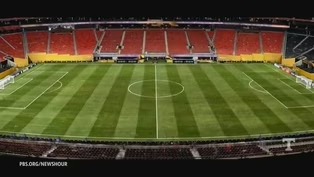
GEOFF BENNETT: As the FIFA World Cup approaches this summer, a key question: What does it take to create the perfect pitch, or field, for soccer's biggest stage?
AMNA NAWAZ: Our correspondent Paul Solman put his body on the line to find out.
PAUL SOLMAN: A soccer ball fired at an unarmed reporter to introduce a global mega-event close to home starting in June, Canada, Mexico and the U.S.... ANNOUNCER: It's Lionel Messi.
PAUL SOLMAN: ... hosting the FIFA Men's World Cup.
JOHN SOROCHAN, University of Tennessee: The single biggest sporting event there is.
The last Men's World Cup final, 20 percent of the world's population tuned in to the final.
PAUL SOLMAN: So there better be no screw-ups.
University of Tennessee turf grass guru John Sorochan has been tasked with ensuring the playing surfaces at this summer's 16 North American venues are pitch-perfect.
What are the stakes here?
JOHN SOROCHAN: It's on the world's biggest stage.
You don't want the field to come into play where the ball's going to bounce wrong or hit something that it compromises or jeopardizes the outcome of the game or heaven forbid a player gets hurt from it.
PAUL SOLMAN: A divot in the natural grass that might cost a team its star, its country, a national depression.
So, the goal: JOHN SOROCHAN: How do we make these surfaces consistent and uniform, knowing that Miami's at sea level and is what we call warm season grass, Bermuda grass, to inside a dome in Vancouver, which would be a cool season grass?
PAUL SOLMAN: Not greener grass, then, just tried, true and unvarying, which has taken years of research.
To test it, Sorochan's team invented a so-called flex machine.
JOHN SOROCHAN: What it does is, it simulates an athlete's foot striking the surface.
So how does it work?
So you basically have a 3-D-printed foot inside there.
You see the foot's retracting so we can measure the speed as it's lowering down, and you can see that's an acceleration condition of a 168-pound athlete.
PAUL SOLMAN: The machine minutely measures how the pitch and player interact.
JOHN SOROCHAN: What the body's going to feel and what the compliance of the surface is.
How much is that surface giving away, what loads is it putting back on the athlete?
PAUL SOLMAN: The perfect pitch must also have the perfect bounce.
JOHN SOROCHAN: From two meters, the ball has to bounce and come back up between 0.6 and one meter.
PAUL SOLMAN: Hence, the ball blasts.
JOHN SOROCHAN: You can see this soccer ball goes through.
PAUL SOLMAN: Then -- whoa.
JOHN SOROCHAN: And it hits.
And we measure that ball hitting the surface, the speed it comes in, the angle, and then the angle and the velocity it comes out at.
And we can come up with a coefficient of restitution to get consistency and uniformity of all the surfaces.
PAUL SOLMAN: Now, World Cup games are played on natural grass.
But half the host arenas have artificial turf.
JOHN SOROCHAN: So those eight stadiums have to get converted temporarily to natural grass.
And of those eight stadiums, five of them are indoors, so dome stadiums that -- no sunlight.
And grass needs sunlight to grow.
PAUL SOLMAN: To make sure it does, different lights for different sites.
JOHN SOROCHAN: So this is the grass that's going to be used in all the five dome stadiums.
And it's been in here for 15 weeks.
And so right now, we're in here, and we have got the normal lights on.
So it's -- quote, unquote -- "nighttime."
So, at 3:00 p.m., the lights come on.
So the sun comes up.
And then this is the light that grows the grass.
JOHN SOROCHAN: We have mostly red light because it's going to be using less electricity.
So it's more energy-efficient.
PAUL SOLMAN: As for the grass itself?
JOHN SOROCHAN: So what they do is they grow the sod over impermeable plastic layer.
So it's being grown on a -- outside, over top of plastic.
And you roll it off with the plastic and deliver it to the stadium.
PAUL SOLMAN: The grass is installed over a layer of sand and reinforced with plastic fibers.
JOHN SOROCHAN: And it basically acts like rebar to stabilize that surface.
And you see these are spaced 20 millimeters apart, a little less than one inch.
PAUL SOLMAN: Sorochan's team ran almost 200 experiments to prepare for the World Cup.
But even the perfect bounce was way too much for me.
For the "PBS News Hour," Paul Solman in Knoxville, Tennessee.
GEOFF BENNETT: We got a full education there.
That was a great story.
GEOFF BENNETT: That's the "News Hour" for tonight.
I'm Geoff Bennett.
AMNA NAWAZ: And I'm Amna Nawaz.
On behalf of the entire "News Hour" team, thank you for joining us.
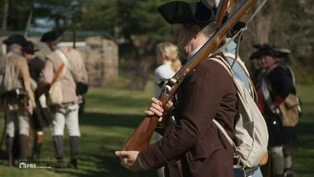
The communities hoping America’s 250th will bridge divides
Video has Closed Captions
The local communities hoping America’s 250th birthday will help bridge divides (9m 24s)
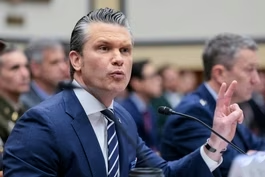
Hegseth’s House hearing shows partisan divide over Iran war
Video has Closed Captions
Hegseth’s contentious hearing in Congress reveals partisan divide over Iran war (5m 40s)
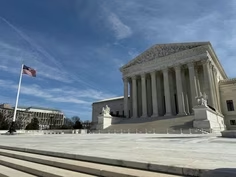
How a Supreme Court decision weakens the Voting Rights Act
Video has Closed Captions
How the Supreme Court’s decision weakens the Voting Rights Act nationwide (10m 33s)
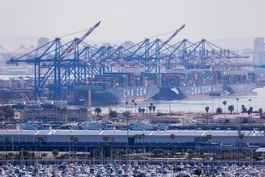
How tariff refunds may affect U.S. businesses and consumers
Video has Closed Captions
How upcoming tariff refunds may affect U.S. businesses and consumers (7m 10s)
News Wrap: Comey denies wrongdoing as he appears in court
Video has Closed Captions
News Wrap: Comey denies wrongdoing as he appears in court over new indictment (5m 54s)
Powell says he will stay on Fed board after chair term ends
Video has Closed Captions
Powell says he will stay on Fed board after chair term ends, addressing Trump’s attacks (5m 26s)
What it takes to create the perfect pitch for the World Cup
Video has Closed Captions
What it takes to create the perfect pitch for the World Cup (4m 4s)
Why Congress is stuck over DHS funding and other key bills
Video has Closed Captions
Why Congress is at an impasse over DHS funding and other critical bills (3m 47s)
Providing Support for PBS.org
Learn Moreabout PBS online sponsorship
- News and Public Affairs

Today's top journalists discuss Washington's current political events and public affairs.

- News and Public Affairs

FRONTLINE is investigative journalism that questions, explains and changes our world.












Support for PBS provided by:
Major corporate funding for the PBS News Hour is provided by BDO, BNSF, Consumer Cellular, American Cruise Lines, and Raymond James. Funding for the PBS NewsHour Weekend is provided by...