
Prairies: Life in Water
Episode 5 | 25m 10sVideo has Closed Captions
From beavers in wetlands to crayfish in streams, aquatic systems shape the prairies.
Water weaves unseen pathways through the prairies, sustaining wetlands, creeks, and rare groundwater habitats teeming with life. From beavers reshaping wetlands to microscopic wildlife drifting through streams and elusive crayfish living deep underground, these aquatic systems reveal the prairies’ hidden vitality.
Problems playing video? | Closed Captioning Feedback
Problems playing video? | Closed Captioning Feedback
Prairies: Life in Water
Episode 5 | 25m 10sVideo has Closed Captions
Water weaves unseen pathways through the prairies, sustaining wetlands, creeks, and rare groundwater habitats teeming with life. From beavers reshaping wetlands to microscopic wildlife drifting through streams and elusive crayfish living deep underground, these aquatic systems reveal the prairies’ hidden vitality.
Problems playing video? | Closed Captioning Feedback
How to Watch Life Unearthed with Ariel Waldman
Life Unearthed with Ariel Waldman is available to stream on pbs.org and the free PBS App, available on iPhone, Apple TV, Android TV, Android smartphones, Amazon Fire TV, Amazon Fire Tablet, Roku, Samsung Smart TV, LG TV, and Vizio.
Providing Support for PBS.org
Learn Moreabout PBS online sponsorship[exciting piano and string music] There's a hidden world thriving in the heart of North America, a wilderness that is rarely seen.
I want to show you one of the most dynamic ecosystems on the entire planet, but it's one that's become virtually invisible to us: the prairies.
Here, grasses grow taller than people, sheltering a dazzling array of wildlife, all perfectly adapted to this flourishing habitat.
To truly see the prairies as the lush, jungle-like landscape that they are, you need to view them from a different perspective.
[grass rustling] I'm journeying deep into this remarkable ecosystem, cameras and microscopes in hand, to discover and document the incredible creatures and landscapes found here.
The prairies are more than just a vast grassland.
They're also a natural cradle for wetlands, creeks, ponds, and springs.
When people think of the prairies, they often think of the tall grasses that stretch for miles.
What they often overlook are all the aquatic ecosystems that snake through them.
It's through documenting the wildlife that depend on these aquatic habitats that we can learn about the interconnected nature and health of prairie ecosystems.
Out here on the prairie, it's easy to be swept up by the wide open skies and oceans of grass.
But hidden among the rolling fields is something else.
[happy string plucking music] Water.
In pools, rivers, and marshy stretches, the prairie overflows with life.
Frogs peek out from the shallows.
[frog chirp] Dragonflies patrol the perimeter.
And crustaceans scurry around at speed.
[light rain and thunder] If you thought the prairie was all dry grass and waving wildflowers, think again.
Tucked between the tall grasses are watery pockets full of surprises that shimmer with life and sound.
[insect, bird, and frog calls] These are wetlands, places where water lingers long enough to saturate the soil and create a hub for wildlife.
I'm here to see for myself just how popular these habitats are in a prairie ecosystem.
[bird calls] From mammals to insects, everyone's here for one reason: lunch.
[fast-paced upbeat orchestral music] You can think of the wetlands as a bustling food market right in the middle of the prairie.
They provide a variety of meals and snacks to wildlife of all sizes.
And in the middle of this bustling food market?
A beaver lodge.
It might look like a messy pile of sticks, but this construction is more than just a cozy little house on the prairie.
It's a full scale wetland renovation.
Muskrats swim around, occasionally emerging from the water for a nice sit-down meal before swimming off to their next engagement.
Birds stalk the shallows, hunting for snacks.
And raccoons tiptoe past looking for leftovers.
[frog chirp] It's a wetland buffet.
And the beaver is the architect behind the feast.
Beavers are ecosystem engineers, shaping the landscape in ways that benefit far more than just themselves.
Their lodges sit at the center of it all.
Sheltered islands in the wetland that offer calm waters and safe cover.
Because wetlands are a reliable source of water, even during drought, beavers will even form their own version of a fast food drive-through for easy access.
If you look closely, you can sometimes find one where the water meets the land.
I'm here at the entrance of a beaver trail.
You can tell, right behind me there's a beaver slide.
And they use this trail to get back and forth between different food sources.
Food sources like this willow stick.
And they actually eat the part of the willow stick that is just underneath the bark.
And you can tell, because if you look carefully here, you can see their teeth marks on the end of it.
Beavers are strict herbivores with a particular fondness for the inner bark of willow, aspen, and birch trees.
That willow stick is just one example from the roughly 200 trees a single beaver may consume each year.
A sizable diet that keeps them busy year-round.
[calm atmospheric music] For many animals and plants, inland wetlands are the only home that they know.
Over a third of the threatened and endangered animals and plants that live in the U.S., can only live in wetlands.
Wetlands are not only key to the wildlife that depend on them, they're also critical to our health and the health of our planet.
By acting as large filters that capture surrounding soil and dead plants over hundreds or even thousands of years, wetlands slow down the decomposition of organic matter.
They accumulate extraordinary amounts of carbon that would otherwise be released into the atmosphere.
Because of this, wetlands are one of our best natural resources in the fight against climate change.
[frog calls and insects whirring] [subtle magical orchestral music] While wetlands offer calm, nutrient-rich havens for many species, other forms of life flourish where water is on the move.
Rivers and creeks can be found carving intricate grooves through the contours of prairie landscapes.
In the summer months, grasses grow so tall that it's possible to stumble into a creek before even seeing it.
Sometimes, to find the most hidden wonders of nature, you have to embrace a little adventure.
So I've suited up, climbed into a utility vehicle, and set off across the open prairie to find a shallow creek concealed within an ocean of grass.
Creeks like these are aqua corridors throughout the prairies.
They snake around and connect different parts and bring different animals together.
But they're also their own special habitat, hosting really different forms of life.
Having more braided creeks throughout a prairie ecosystem is really important, because they create little nooks and corners for all different types of life to flourish.
With deeper creeks, it's harder for more biodiversity to take a foothold.
But with these braided, more shallow creeks, you have more healthy ecosystems.
Researchers and volunteers and nature enthusiasts with the RiverWatch program come here to tally what different types of life that they see.
To inform us about how healthy this ecosystem is.
The people that study these rivers included in the RiverWatch program are a patchwork of different people from different backgrounds.
Much like the prairies are a patchwork of different ecosystems coming together.
After learning a few techniques from the RiverWatch volunteers, I decided to see what life I could dredge up.
So finding some of these creek creatures is really a matter of getting them to dislodge from the rocks.
So I've got this net.
I'm going to try and see what little invertebrates we can get.
Good place to find them is up on the banks of the river here.
And if I just take the net and I sort of agitate the sides here and get some soil to come up.
All right, let's see what we got.
Here is a little scud, a little freshwater shrimp.
Oh!
A lot of clams.
So some of these clams are rare and endangered.
And we'll be putting them back.
But we also have a snail.
What I'm looking for as I push through this mud through my fingers, is trying to find anything that's in motion.
Life is often in motion.
That's how we identify it all over the planet.
And it's actually something that might be really useful to use to try and identify life on other planets and moons in our solar system and beyond.
Motion is a biosignature.
All life moves, whether it's at the cellular level or as large as bison.
[intense guitar music] Over the last half century, as space probes have journeyed across our solar system, they have detected water under the icy surfaces of Saturn's moon Enceladus and Jupiter's moon Europa.
To investigate whether there are microscopic organisms living in that water, scientists, with the help of astronauts on the International Space Station, are testing special microscopes that they hope to one day put on a space probe.
By using a technique similar to a hologram, their microscope can detect tiny, micron-scale bacteria moving through liquid.
If there is microscopic life in our solar system, we may find it by looking for movement in a cup of water.
I wanted to take an even closer look at some of the biodiversity that thrives in shallow creeks.
So I trekked over to a different corner of the prairies to see what I could find with my microscope.
[curious synth music] In this stream, a film of biological activity coats the surface.
Under my microscope, I could see the beautiful, long filaments of algae that made up the film.
I also found other types of algae gliding through the creek.
Diatoms.
Diatoms are single cells of algae encased in beautifully geometric glass houses that they construct themselves.
Despite their glass houses lending them some protection, they're no match for hungry ciliates.
Ciliates, with their hair-like fringe that sweep in food, love diatoms so much that once they've eaten one, they can't help but gorge themselves until they're so full they can barely move.
While these microscopic battles unfold, other residents make their presence known in the creek.
[mysterious string music] One resident that you can just barely make out with your naked eye are midge larvae.
Also known as blood worms, midge larvae are the juvenile stage of non-biting flies and are packed with hemoglobin, just like the kind in our blood.
But they're not vampires feasting on blood.
Instead, they eat by straining dead plants and microorganisms through the fast moving brushes surrounding their mouth.
In the quiet corners of the prairie, there are places that feel untouched by time: fens.
Not quite swamp.
Not quite marsh.
A fen is something else entirely.
A rare wetland where groundwater slowly seeps to the surface, creating a landscape that is both lush and ancient.
[birds singing] I've come here, boots squelching through the saturated earth, wading through the grasses nearly as tall as I am to see it for myself.
At first glance, it's a tangle of plants, but the longer I look, the more I begin to notice.
What fascinates me is how such a delicate place can be so full of complexity.
Because of the underground water, the ground out here is really squishy, like a sponge, and it was difficult to find my footing, but worth it to be able to see this.
[exciting orchestral music] When I trekked through a maze of tall grasses to see could easily go unnoticed by the unassuming observer.
Bubbling gently away in a small clearing is a sand boil.
[bubbling noises] This is the result of water that got trapped underground under layers of sandstone that are putting pressure on it, and that pressure results in that water pushing up through cracks and fissures of that sandstone until it bubbles up.
And it's taking little grains of sandstone with it along the way.
And actually creating that sand-boiling look, which is just a rare treat and something that's really important for us to protect.
Sand boils like this one offer a glimpse into a hidden world beneath our feet.
A slow, steady process that's been unfolding for thousands of years.
The movement of water through the sandstone isn't just a geological quirk.
It's a fragile feature that only survives in landscapes left untouched.
This is a powerful indicator of a well protected ecosystem that hasn't been drained for agricultural or urban use.
The reason why sand boils are so important to see is because they're a visual marker of an undisturbed prairie.
Long ago, prairies would have had lots of sand boils around them.
But once they become disturbed and that water gets pushed out of the ground, there's no more sand boils.
So this is proof that this area has never had structures or anything like that on it, because it still exists today.
Just a short walk from the sand boil, the prairie holds another surprise, one that lives entirely out of sight.
I'm here in search of the Great Plains Mudbug, a species of crayfish that's chosen a very different path from its creek dwelling cousins.
You can typically find crayfish in freshwater streams and lakes, often hiding amongst the rocks and cautiously darting around.
Their specialized gills allow them to breathe both underwater and on land, as long as there is enough moisture in the air.
Crayfish are also remarkable because of how sensitive they are to pollution.
To survive, they require habitats with clean water.
All right, so we're at the site of what is the Great Plains Mudbug, which is the most wonderful name of any wildlife out here, if you ask me.
And what this is, is that it's actually crayfish.
They're crayfish that burrow underground in the mud until they reach the water table.
So instead of living in the creek, they actually live deep underground.
And I've got an endoscope that is usually used for, well, snaking sewer systems.
And I'm going to try and snake it down one of these holes and see if we can find one of these crayfish.
All right.
So first I'm getting a shot of myself with this camera to see myself and see if I can see everything.
Everything looks good.
The light's really bright, so I'm going to snake this down now.
We're going to go on an adventure.
Find this Mudbug.
[funny synth music] So I'm seeing roots.
Can definitely see something snaked its way through this hole.
[gasp] Oh my God, there's a claw!
Oh my God, we found him!
[gasp] Ah!
So cool!
Okay.
Let's see.
Lost him.
But I definitely saw a claw.
I was like oh my God!
[laughs] Most annoying nature host.
Sadly, my endoscope footage was far from anything conclusive.
So I tagged along with a couple of crayfish researchers in pursuit of the Great Plains Mudbug.
[determined synth music] You'll find the burrows of these elusive crustaceans by looking for piles of mud surrounding small holes near creeks.
To study these creatures up close, we've got to scoop them out of their burrows temporarily, which is no easy task.
The burrows are so deep that researchers must submerge their entire bare arm into the mud to feel around for them.
And when that fails, they use their arm to plunge the burrows to get them to come up.
It's not dissimilar to the act of plunging a toilet, and it sounds like it, too.
[plunging noises] Finally, after a lot of plunging, we were successful in getting to see one outside of its burrow.
[calm orchestral music] I'm really excited today to be able to see this crayfish finally in person.
It was really difficult in order to get into their burrows.
They go so far down, down to the water table and being able to see this little friend up close and personal, I don't know.
It's just really marvelous to be able to see such a cool, cool animal that calls the prairies its home.
At a time when freshwater biodiversity is in measurable decline, studying unique aquatic creatures, such as the Great Plains Mudbug, is key to understanding the health of prairie ecosystems and recognizing special habitats they depend on to survive.
[birds singing] The plants and animals of the prairies depend on the reliable access to water that creeks provide.
Yet over the years, an increasing number of creek beds are going dry.
Where I'm at is the site of a mystery.
Despite years of increased rainfall, creeks like this one have been drying up all across the prairies.
[mysterious orchestral music] Researchers began probing these dry creek beds to look for answers, and what they found was that the water was not even filtering through the soil like they expected it to.
It was bypassing it.
Someone or something was stealing all the water.
They didn't have to go far to find the culprit.
As you can see behind me, all of those are shrubs.
And those shrubs have roots that go thick and deep into the earth, dominating the land and out competing all the other prairie plants and the creek for water.
Normally, after it rains, water soaks into the earth where plant roots take up what they need and leave the rest, creating groundwater that percolates through the soil and pours into creeks.
Recent increases in shrubs along the edges of creeks have been interrupting this water cycle, leaving creeks, prairie grasses, and the wildlife that rely on them high and dry.
It has become such a common problem in prairie ecosystems that it has a dedicated name: woody encroachment.
Without regular fires, these woody shrubs become even more abundant, and the CO2 that we pump into our atmosphere adds insult to injury, making them grow even faster.
The result of woody encroachment threatens not only the vital creeks that wind throughout the prairies, but the grasslands that define prairies themselves.
[serene orchestral music] From hidden aquifers to seasonal wetlands, water is what shapes the prairies.
On Earth, where there's water, there's life.
Notably, the Kaw people, who once inhabited these lands, before they were forcibly removed, have the same word for life and for water: ni.
Prairie wetlands, creeks, and ponds may seem fairly modest compared to larger bodies of water, but they're no less remarkable.
These waters are the arteries of the grasslands, nourishing an intricate web of life.
Countless microscopic animals, insects, fish, amphibians, birds and mammals all depend on their ebb and flow.
But today, these life giving waters face unprecedented challenges.
Climate change brings both prolonged droughts and increased flooding, altering the delicate balance that has endured for millennia.
An expanding human footprint also strains these ecosystems, often in the form of pollution and groundwater depletion.
The clean and reliable water sources in prairies that support its rich biodiversity are at risk of vanishing.
But the power to protect these waters and the life they sustain is in our hands.
Across the prairies, people are finding ways to document and care for the land and water.
Reminders that even small acts can help nature endure.
[uplifting piano music]
Video has Closed Captions
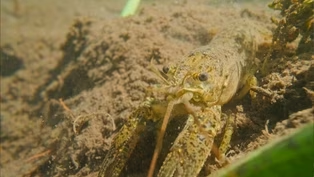
Preview: Ep5 | 30s | From beavers in wetlands to crayfish in streams, aquatic systems shape the prairies. (30s)
Video has Closed Captions
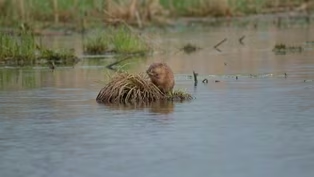
Clip: Ep5 | 2m 45s | Wildlife are here for one reason: lunch! (2m 45s)
Providing Support for PBS.org
Learn Moreabout PBS online sponsorship
- Science and Nature

Explore scientific discoveries on television's most acclaimed science documentary series.

- Science and Nature

Capturing the splendor of the natural world, from the African plains to the Antarctic ice.


 New Episode







Support for PBS provided by: