Mountainthology
Mountainthology x Inside Appalachia Special
4/27/2026 | 27m 48sVideo has Closed Captions
Guest host Mason Adams of Inside Appalachia brings us four stories from Folkways reporters.
Guest host Mason Adams of Inside Appalachia brings us four stories from Folkways reporters about craftsmanship and resilience. Plus, an interview with Mason!
Problems playing video? | Closed Captioning Feedback
Problems playing video? | Closed Captioning Feedback
Mountainthology is a local public television program presented by WVPB
Mountainthology
Mountainthology x Inside Appalachia Special
4/27/2026 | 27m 48sVideo has Closed Captions
Guest host Mason Adams of Inside Appalachia brings us four stories from Folkways reporters about craftsmanship and resilience. Plus, an interview with Mason!
Problems playing video? | Closed Captioning Feedback
Where to Watch Mountainthology
Mountainthology is available to stream on pbs.org and the PBS app.
Providing Support for PBS.org
Learn Moreabout PBS online sponsorshipThis is a production of West Virginia Public Broadcasting.
Hey there.
I'm David Marcum and welcome to a very special episode of Mountanthology This month, we're working with the award winning team from Inside Appalachia to bring you four stories, not only from West Virginia, but from our Appalachian neighbor states as well.
With that, here's our modest anchor, mountain ambassador, Mr.
Appalachia, Mason Adams.
Huh?
Eh.
Most of the time, athletes welcome technical innovations in sports equipment.
Gone are the days when folks ran marathons and converse sneakers.
And you don't hear basketball players pining for 1970s style short shorts.
But some fly fishermen still prefer to do things the old fashioned way, using tackl made from traditional materials.
Folkways reporte Zach Harold takes us to the Elk River to meet Lee Orr of the 304 Rod Company.
My dad is from Montana, so every year we would go to Montana.
He would take all his vacation at once so wed spend the whole month of August.
We would, fish every other day.
A couple guys came up this little creek, this, think it's Little Bear Creek or something.
It's up near the Wyoming border.
Might actually be in Wyoming.
And they just for catching fish one after the other.
So I told my dad, it's lik I want to learn how to fly fish.
That cast a lot of old bamboo rods.
Before, I was not a fan.
Big, long, heavy things.
And, where to fly fishing school.
The Trout Unlimited ran, and somebody had a little seven foot Orvis bamboo rod, and I cast that and, and I really liked it.
And, did some research and was shocked to find that you can buil these things in your basement.
So I said, I'll learn how to do that.
Process is is a 12ft long section of bamboo pole of bamboo also known as a culm - c u l m. And within that thing you cut it in half and you take that bamboo and you split it.
You actually take a knife and twist and break it apart, and then you break it down into six individual strips, and then you have to work it and straighten it, get the little bumps and hooves out of it.
And then you put it in what's called a planing form.
and you use a hand plane.
And this steel form has a taper in there.
And so you're making a 60 degree angle on each one of these strips and with a taper in it.
So then you wind up with six 6 degree strips tapered that you then roll back up together and glue together.
When started there was a old-time... this sounds like ancient history So it was an email list serve You go in and ask questions and people would answer you, and then there's a bambo rod forum that's still active.
Buncha just a bunch of old cranky old g It's kind of the community with a really helpful but passing down information.
The guide makers that I have, there was a plans online and I didn't have the things for it, and someone sent m all the stuff from all the brass rod and the set screws and outs and just said, hey, you, next time somebod else, need something, you just you just kind of pay it forward kind of thing.
So.
And I've done that as an old chunk of, American chestnut in an old house that had fallen dow and got on that forum and say, hey, anybody want some American chestnut to make some some real seats out of and, one of shipping and stuff all over to people that, you know, want it.
Just give me the shipping and I'll send you the wood and stuff.
So I sell several rods throughout the course of a yea you know, 10 to 15 rods a year.
It's not a lucrative thing.
There's no way I can retire off of making making fly rods, but it pays for the for the entertainment/hobby part of it.
There's tradition.
There's rules of things you have to do.
You have to use silk thread.
You have to use a metal called nickel silver.
And so this is the way you do it.
Because you want to continue on this, this trend.
There's still a couple of pieces I don't make, but eventually get to the point where I would like to make, ste to stern, every bit of it myself I gotta probably retire before I do that and get a little more equipment.
This one is...of course I probably didn't put a date on.
I just put a number.
This is the 13th...11th one So that's probably.
I don't know, 17 years old or somewhere around in there.
There's the, the handmade part of it, which sometimes lends itsel to a little bit of imperfection.
Why would you want it to be perfect?
You want it to be loo like somebody handcrafted that in West Virginia, it's harder to catch fish on a fly rod than it is spinning around, because our streams are typically really small.
If I would just wanted to go catch fish, I would go fish carbon rod in that fish live bait and I would catch more fish.
It's relatively cheap, easy to get, works just fine.
But there's a lot of things that work just fine there, just to kind of lack a little bit of soul to them.
It's not just the fishing part.
I'm also in a creek away from everybody and up in the mountains, and that's that's the appeal of that.
And Highland County, Virginia and its neighboring counties in West Virginia.
Making maple syrup has become tradition.
They're some of the southernmost areas in the U where maple syrup can be made.
These days, producers are experimenting.
Both out of curiosity and out of necessity.
Folkways reporter Claira Hazlett visited Highland County to learn about the process and the sticky situation that comes with the change in seasons.
(Crowd chatter) (loudspeaker) It's that time of year again.
The Highland County Maple Festival has been a staple for over 60 years here in Highland County.
In 1959, we'll have ten local sugar camps.
You can see traditional methods as well as modern ones.
It's an old school way of doing it.
I was born down the road, bout three quarters ‘a mile.
Every farm had a sugar shack.
And it wasn't mainly for syrup.
It was mainly for sugar.
Pat started helping his dad make syrup when he was eight years old.
And we've been doing it together for 23 years.
He won't tell you this, bu he has maple syrup in his veins, and he would make syrup 365 days a year if he could.
It's been 4 or 5 generations of Puffin Burgers back from the 1700s.
Here at these mountains.
Yeah, we're just suited for the maple trees and making maple syrup.
It's just very traditional.
So we're trying to, like, break the traditions a little bit.
People get asked, and what you have it's name?
No, my had anything.
You know, it was new.
It was?
Yeah.
Light syrup.
Medium served.
Dark syrup.
So what?
We started to experiment with the infusions.
Now we are going to do chili pepper and ginger.
And read about some hickory syrup.
And a guy made.
And hickory is mad from the bark of a hickory tree.
You'll get this next.
My husband loves to make syrup so he can make thi when he can't make maple syrup.
It has to be above freezing during the day.
Walnut syrup is made, in theory, exactly like maple syrup.
It's the tree is tapped.
The sap is harvested and brought back and boiled.
Walnut specifically, is what we specialize in.
Which is kind of like a frontier.
There's a lot of things to learn.
Still just as the season goes, like, this season was a littl unpredictable with the weather.
It was unseasonably warm in February for this region.
So a lot of the West Virginia in this part of Virginia producers didn't have a great season.
To be honest.
The first, I would say ten years that we made syrup together.
It was pretty regular.
This yea it's kind of all over the place.
Honestly, I have in my 71 years I have never seen a February like this.
Where again, one cold nights, perfect.
40 in the day is perfect.
You get up to 60 and 70.
This year was a little different.
My husband decided about re drilling trees, taking the taps out and just making a whole new hole.
So he did that this past wee and he's never done that before.
With the warm temperatures i February the climates change in.
And that might be a new thing we're going to do.
Even this Maple festival, there's talk about having tha earlier because over the years it's become less and less in the middle of the season.
But you see it an it fills up with the tree juice.
And then we get syrup.
CBC we're just kind of depending on God to that.
The trees, you know, will bud out every year.
And so we will have a maple season of some sort, even though it's unpredictable and it's, it's very hard, like labor intensive.
I like that aspect about it.
To me it has a calming effect.
If I have a hard day, even if we're not doing anything, if you're the sugar shack, I will come up here, set on the porch and watch the sun go down and it makes me feel better.
Some people play golf.
Some people fish and some people make maple sugars.
The fur trade has been around for a long time.
In fact, it was one of Appalachia first industries before coal or timber, European trader and settlers swapped iron tools and cookware for animal skins collected by native hunters.
The skins were sent overseas and made a splash in the European fashion scene.
Trapping was still lucrative well into the latter part of the 20th century.
These days, West Virginia fur trappers struggled to earn a living.
The market is fickle and tie to fashion and public opinion.
Despite the instability, some trappers in West Virginia have adapted.
They've gone on to snare new career using their particular skills.
Vocalize reporters Laure Griffin and Clara Hazlitt bring us this story.
I do have a genuine fear that whenever I am in my 50s or 60s, tha there will not be as many of us.
But the reaso that it's not going to go away.
This is for most of us, this is not a hobby.
This is this is who we are.
I'm the owner of Wend Rich, trapper, founded in Work County, West Virginia, by my dad, Jason Steller.
I guess right there.
You know, if you're a butler, you're pretty much expected you're either going to b a preacher or a trapper or both.
That's one of them right there.
But I'll get out on the bank and get it all right.
We specialize in beaver trapping.
It's all.
Every animal has its own niche.
You see em?
Muskrats go in the water.
The beaver market is almost always primarily for for for hats.
That' just what beavers are there for.
The two biggest things we do is buying fu and selling trapping supplies.
After we receive the animal in, whether we buy it or whether we catch it, we will skin it.
We use the hide to make money off of it.
We take it to market and sell it in.
Three XL heavy raccoons 29 to 35in.
There's one.
To give a $5 bill.
Let's get it started.
Do that and work your way up.
Three and a half.
Two and a half ago.
Thre and a half and three and a half.
And we got three and a half.
Two and a half to go, three and a half.
But they're going to have to be going forward to have them over to have to go over to have a good five.
And I am going to have seven and a half and eating, and I'm going to have 11, and we'll have 10 to 12 and 12 and 12.5 to them.
And what do you thinking about having a good 11 to have 1 in 11, 11.5 in 15.
Fire number nine.
And $1,510.
The fur auction of Glenville is one of my favorite days of the year.
I look forward to it just like a vacation.
Me and all.
Like, it's such a big deal to me and my family that all of my buddies will go up there.
It's a Friday, Saturday, Sunday thing.
So whenever as soon as we get off work Friday, we all hop in the car and we stay there the whole weekend.
It's it's a really special thing to us.
And I was hoping you'd make it all right.
We got one grease coon donated by Austin Sutler to the general fund.
And remember, whether it's general fun or the education fund, they help with the young trapper that are just getting started.
All right, here we go.
What I get for to pay you to get better.
To get better.
So I'm Jeremiah Potlatch.
I'm West Virginia Travel Association president.
This is a fraction of what for ourselves normally usually this whole back floor here is piled with coon in our good years, you know, good Caesar, which I'm.
I'm really optimistic about next couple of years.
Every so many years they say that there's a fur band, you know, where prices go up and down really drastically and stuff like that.
It's all supply and demand, really.
Our membership fluctuates with the the prices too.
You guys go throug a lot of hard work and you do it because you love it, because there have been no money in this for a couple of years now.
But the ones that you see her now, let's got the fur up, are the diehard trappers that do it, because that's what they've done all their life, and they love it and they support it.
So they're going to continue to trap it.
Don't matter what the market is doing it again, give me a $10 bill way back.
Buyer seven.
We didn't buy that much this year because of the state of the fur market.
And we didn't trap as much as here's what we normally do, but probably around half of the beavers that were out for auction were ours.
We also brought some bobcats and kites and cans of.
It's a dying breed.
There's not very many people to do it.
And whenever you get with a small group of people that still care about it and that they identif with the same, the same beliefs that you do, it' gets a special kind of feeling.
From the.
It's something that a lot of people are not okay with.
Whenever I was a kid there were multiple times a dad either got phone calls or letters in the mail with peopl telling them that he was crazy and that we were bad people for the things that we did.
But I have absolutely no remorse for anything that we do.
I know that everything that we do has a purpose.
We do everything as humanely as possible.
Even after it has passed.
We try to put up a quality product and it gives that animal's life more meaning.
Yeah, we got it.
We got to be able.
Yeah.
Small wonder we got one.
It's all abou just taking pride in something that not very many people do anymore.
To remember the things that our families have taught us.
It's kind of a big deal for us.
Looks perfect!
When John Haywood was 13 years old, he got his first guitar and his first tattoo.
Years later, John's now the proprietor of Parlor Room Art and Tattoo in Whitesburg, Kentucky, where some folks are picking design and others are picking strings.
Folkways reporter Zac Harold visited Parlor Room, where a community bonds ove tattoos and traditional music.
Tattooing and having a tattoo shop and a place like this and ain't really just about a tattoo and, you know, it's about these folks that come in.
It's about providing a place for, folks to feel comfortable at.
The lobby's pretty much serves as kind of, art gallery.
Just to kind of vibe the place, make sure there's plenty of designs and flesh and inspiration around, because everybody tends t bring in a lot of the same old, same old on the internet.
So we try to keep a unique sort of something to kind of get their brains maybe looking at, some art or maybe looking at some traditional books and stuff like that.
And do.
That for, I remember at one time saying, Johnny, what do you want, man?
You know, you're here, you're done, you're showing up, you're taking out the trash.
You're getting us food.
You know, I was like, well, we'll give you free tattoos.
And then you start to realize that there's no way I can do that many tattoos, I don't know, at some point it just became an apprenticeship.
I'll be honest with you.
You can go online and learn, you know, and find somebody explaining everything you want to know about this.
But the what you don't get from that is the importance of learnin how to connect with clientele, seeing like what they may be going through when they come through the doors, what they may be thinking of they're not artists, you know, but we are.
(customer) Few hours maybe?
Yeah, I'd say about four hours.
Ive known John for a long time.
We go way back to back, playing metal music, punk music stuff back in the back when I was in, you know, high school age.
So John opened a shop, naturally that's where I come to.
He's done a full sleeve, full back piece Full front piece and some leg work We were friends and knew each other, but because he came and started getting tattoos, that was where, you know, that was that really made our friendship.
I've got stage four colon cancer.
So, you know, I'm traveling to Lexington for treatment over two weeks, and I made three majo surgeries in the last two years, and probabl since the first was diagnoses, I always checked in on me message.
I mean, to me, I was I was just like, there's something we've got to do.
What if we made just like a sheet and these designs and that any time they get a tattoo of this, we can put the sharp commission towards Brad.
And sit on the table.
Let me hold it.
The simple bits and pieces here.
How to clean at a black snake.
The got an arrowhead.
So a. Couple frogs.
This is similar with their long handle underwear.
Somebody says that Keith Whitley with the wrong, you know, the solidarity in the support probably.
I mean, means more than even the I mean, the money's secondary to, you know, this the support it makes you feel The inspiration for the parlor room.
I liked the idea of it being a little social hangout spot.
It just kind of naturally became that because there's just who we are.
Yeah.
That was our.
Our friends were here ready to help the folks that hung around the shop and the folks that hung around our little music community that really sort of banded together.
And we we pulled together during all that stuff.
And made it work.
And I've always been a shy social person.
Music and art has always been my best way to communicate to folks, and I've just had to learn to embrace that.
And I might not be the best person with words or whatever, but, but, I hope to be able to contribute something, you know, through the form of music and art.
Funny wha tattoo and does for folks and, and it's, you know, when you put something on someone and they walk out of here, feel like you see the feeling better about something and know it feels pretty good to know that you can do that for someone.
I'm Mason Adams.
I'm host of Inside Appalachia.
Inside Appalachia is a radio show and podcast that is by and for and about the folks who live in the Appalachian Mountains.
I found it as a podcast years before I worked for it and began listening.
While I would listen to it while I was milking goats in the mornings I then became one of the first of Inside Appalachia folkways reporters when I applied for the program in 2018.
My first story aired in 2019, and then in 2020, I became co-host of the show along with Caitlin Tan.
Caitlin has eventually left and now I host Inside Appalachia myself.
Yeah.
I grew up on the Virginia/West Virginia border and actually went to school for wildlife but I was drawn to journalism.
It wasn't just a job for me.
It was a calling.
And one of the things I really was into was these bigger picture stories about the Blue Ridge, about Appalachia.
So when I made the decision to leave wildlife biology and get into journalism, it was really important to me to tell regional stories.
So there's so much focus on national news.
Everybody follows what's happening in Washington, D.C.
and the big East Coast metros, and that's important.
But Appalachia is a whole region.
And it's people have often been overlooked through the years, or they've been not allowed to tell their own stories.
So inside Appalachia is an avenue to tell Appalachian stories.
With this kind of we have this ethos of all y'all.
We feel like all of these perspectives are important across geography, across race and class and ethnicity and gender.
Everybody's got a story to tell, and we want to tell the authentic story of Appalachia as told by its folks.
for me, the best storie come from just listening Really, the essence of a story is about that person and the human experience.
That' how we connect with each other.
Thanks for joining us on this special collaborative episode of Mountainthology.
And a big thank you to the folks from inside Appalachia.
You can find audio episode wherever you get your podcasts and find video pieces like these on our website and YouTube channel.
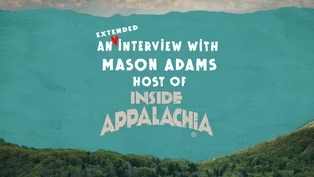
If you visit us on passport you can see an extended version of our interview with Mason Adams.
Thanks for watching.
See you next time.
This has been a production of West Virginia Public Broadcasting.
An (Extended) Interview with Mason Adams
Video has Closed Captions
An interview with Mason Adams, host of Inside Appalachia (8m 14s)
Providing Support for PBS.org
Learn Moreabout PBS online sponsorship New Season
- Drama

Hugh Bonneville stars in a crime drama inspired by one of the largest robberies in British history.
 New Episode
- News and Public Affairs

Top journalists deliver compelling original analysis of the hour's headlines.
 New Season
 New Episode
 New Episode

 New Episode


Support for PBS provided by:
Mountainthology is a local public television program presented by WVPB