WEDU Arts Plus
1310 | Episode
Season 13 Episode 10 | 26m 10sVideo has Closed Captions
Tarot cards featuring people of color | A pinstriper | Art helping grief | Paper sculptures
Multimedia artist Courtney Alexander creates a tarot deck featuring people of color and themes of the Black diaspora. Jim "Dauber" Farr is a master pinstriper honing his craft over 40 years. The Solace Tree is a nonprofit organization providing art services and support groups to those struggling with grief. Artist Lea Gray transforms paper into realistic, intricate sculptures inspired by nature.
Problems playing video? | Closed Captioning Feedback
Problems playing video? | Closed Captioning Feedback
WEDU Arts Plus is a local public television program presented by WEDU
Major funding for WEDU Arts Plus is provided through the generosity of Charles Rosenblum, The State of Florida and Division of Arts and Culture and the National Endowment for the Arts, and the Hillsborough County Board of County Commissioners.
WEDU Arts Plus
1310 | Episode
Season 13 Episode 10 | 26m 10sVideo has Closed Captions
Multimedia artist Courtney Alexander creates a tarot deck featuring people of color and themes of the Black diaspora. Jim "Dauber" Farr is a master pinstriper honing his craft over 40 years. The Solace Tree is a nonprofit organization providing art services and support groups to those struggling with grief. Artist Lea Gray transforms paper into realistic, intricate sculptures inspired by nature.
Problems playing video? | Closed Captioning Feedback
How to Watch WEDU Arts Plus
WEDU Arts Plus is available to stream on pbs.org and the free PBS App, available on iPhone, Apple TV, Android TV, Android smartphones, Amazon Fire TV, Amazon Fire Tablet, Roku, Samsung Smart TV, and Vizio.
Providing Support for PBS.org
Learn Moreabout PBS online sponsorship- [Announcer] This is a production of WEDU PBS, Tampa, St. Petersburg, Sarasota.
- [Dalia] In this edition of WEDU Arts Plus, a local artist creates a one of a kind tarot card deck.
- My inspiration has come from all different types of places the same way, like I said, blackness is existing in all these classes.
I just was able to kind of find a way to pull all these different types of identities together the best way I could.
- [Dalia] Freehand pinstriping.
- [Jim] Everything I do is done the original way, the right way.
I like the smell of paint.
I like the feel of brushes in my hands.
I wanna do it right or not at all.
- [Dalia] Finding solace through artistic expression.
- It's a privilege when a child gets on a canvas and they share all their feelings on the art and then they get to share it with us as a group.
- [Dalia] And paper sculptures of the natural world.
- [Lea] It's always the little things.
It's the meticulous little details, the magic behind nature, the spirit of nature.
That's what I am inspired by.
- It's all coming up next on WEDU Arts Plus.
(bright music) Hello, I'm Dalia Colon, and this is WEDU Arts Plus.
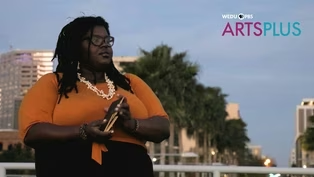
Courtney Alexander is a multimedia artist who has taken the tarot world to task.
Noticing the absence of people of color featured in tarot cards, she created a deck featuring people of color and themes that speak to the black diaspora.
(light music) - I've been creative in my own way all of my life, but I never thought of myself as an artist, like someone who had something to say.
I didn't see myself in museums or doing paintings or anything like that.
And when it was time for me to go to the University of South Florida, I had decided to go into their studio fine art program.
Throughout my time at USF, like I transformed not just as an artist but as a person.
I feel like my transformation as a person informed my transformation as an artist.
And I realized that I had things to say and I had things to share.
It made me want to start to kind of break down some of the experiences that I had and understand my identity at these intersections of being fat, black, and queer.
With tarot, it was kind of like a little journey that I took baby steps in.
Last year, I was like ready to finally purchase my own physical deck.
And so I did.
There were a lot of options out there, but none of them featured people who looked like me.
And although I did find one deck that I felt comfortable with, I still wanted to have something that represented who I felt I am as a black person who's raised in America.
Like I don't have a lot of connections to traditional African practices.
And so I was like, "Man, I would really love to have a deck that just was free.
It just represented the diaspora.
Like it represented the multiple ways that blackness can exist instead of just catering to one aspect of blackness at one time.
Like we are all these things at the same time."
I started off with the death card of all cards.
And from there, I just continued to find references that inspired me.
I felt like Grace Jones represented a lot of the things that I wanted to bring into this project.
She's, to me, someone who's fierce, who's bold.
She's just unapologetic about all facets of herself, and she doesn't allow anyone to place her in a box.
And it just continued for me finding inspiration that even outside of Grace Jones, just looking at photos of whether it was celebrities or people from different African countries.
So my inspiration has come from all different types of places the same way, like I said, blackness is existing in all these facets.
I just was able to kind of find a way to pull all these different types of identities together the best way I could.
- I've been doing tarot oracle readings for about four or five years now, and I've had so much experience with trying out different layouts.
But when I laid my eyes on Dust 2 Onyx, oh my goodness, it is, when I'm looking at the pictures and I'm seeing Grace Jones and you see, like it's amazing.
I've just never seen it before.
I've never seen it done like that before - ever.
- Representation is important.
Seeing people that look like me is important.
Having the history of tarot and knowing where it came from and knowing that I have roots in it and that my people have roots in it, and those being acknowledged when they're so often overlooked, there are so many, you know, there's the classic tarot deck that everybody goes to that I'm not gonna name 'cause I'm sure everybody knows what it is.
And that has for so long been the standard.
And the problem with that being the standard is, where am I in that deck?
So it's super important that here is a deck that has all of these representations that I can relate to.
Representations of women, representations of black women, representations of fat, black women.
That's all super important to me.
Representation matters.
Me being able to get grounded, me being able to resonate with somebody, me being able to give better readings, I judge that's all a result of feeling very connected to my deck.
That's why this deck is so pivotal.
That's why this deck is so necessary.
(bright music) - [Courtney] With this work, I just started off on Bristol paper, which is a kind of thick, smooth white paper, and I spray painted it black.
I just started withdrawing with pastel.
I would draw the portrait out, and then I had magazine clippings.
I had different types of specialty art papers, glitters, sand, puffy paint.
Like I just had all of these things around in my art studio that I had accumulated, and I just began grabbing those things and working with them.
- She put so much time and so much thought, and so much intuition and energy into every stroke that you see on these cards or every stroke of the brush.
It's incredible.
Courtney has really opened up a space for a melanated people, people at the African diaspora to feel at home, to feel connected truly to this deck and see themselves reflected in that.
And I feel like these images not only can serve as sources of healing but inspiration.
- I just really hope in the end that those who receive this tarot deck just really understand the amount of genuine love and genuine spiritual transformation.
Everything that I've experienced has gone into it.
It's living and it's breathing.
And it has its own intention for each and every person that receives it.
And I'm excited what this means for the tarot community.
I'm excited for what this means for the black community and for the art community.
- To learn more about Courtney Alexander's work, visit dust2onyx.com.
Meet Jim "Dauber" Farr, a hall of fame master pinstriper.
For over 40 years, he has been working on his craft, transforming cars into one of a kind customized creations.
We head to Cincinnati, Ohio for the story.
- When I was a preteen, there was a point where I quit buying comic books and started buying car magazines.
I was fascinated by the designs.
And eventually, I found a magazine that showed Dean Jeffries doing some pinstriping in an old car.
And he had a striping brush in his hand.
I got on my bike, pedaled down to the Sherwin-Williams store, back wall, had striping brushes, so I bought the smallest brush that would fit my hand, and it helped me learn how to do skinny lines.
I'm Jim "Dauber" Farr.
I'm a pinstriper, gilder, commercial artist, graphic artist.
Happy to be here.
There was an occasion when I was at the art museum viewing the show, "Women of Egypt."
And at the end of the show, there were two caskets encased in plexiglass.
And there was pinstriping on these caskets.
I knelt down to look at them, and I couldn't resist drawing my hand across the plastic, imagining what that wood would've felt like with a brush in my hand.
And when I drew the brush back like that, there was a thunder boomer overhead and the lights went out.
And I had my hand there, and I looked up at my friends who were standing there and I took my hand away.
And for some reason, the lights came back on, and it just sort of seemed to be somewhat karmic, if you take my drift.
Dauber came into my life when I was working in my partner's shop, Bill Roell, over in Covington.
We worked together for almost 10 years.
And there was a guy from the west side of town who came in and was watching me letter.
And the lighting was very inadequate.
And I kept wiping paint off on my shirt 'cause I couldn't get it the way I wanted on the car.
And this gentleman was standing there looking at me doing that.
And he says, "This guy daubs more than he paints.
We ought to call him Dauber."
Within a week, the concrete had dried and I had no choice in the matter.
I actually am pinstriping in gold leaf, and not too many people do that.
You mix a sizing, a glue, which is commonly known as a sizing, and you a mix glue and usually some color with that.
So you have an image of what you're actually putting down, and you let it dry a certain amount of time, depending on the weather and the thunder and lightning and also the humidity and whatnot.
And once it's ready, it's ready.
And if you don't pay attention to the clock, you can find yourself having wasted some time and possibly material.
And it's entertaining sometimes but also challenging.
You've got to pay attention to detail.
Simple as that.
Gold leaf has a tradition in a history that goes back centuries, literally centuries.
The Egyptians were doing it and possibly further back than that.
It came into vogue again during the Renaissance, actually prior to the Renaissance and so forth, subsequently in churches and things of that nature, began being used on picture frames and things like that.
I know of maybe five or six other stripers nationally that do pinstriping in gold leaf on the streets.
There may be more but I'm unaware of it.
Where do I get inspiration from?
Everywhere.
I'm blessed with powers of observation and I try to be receptive and I try to pay attention to things.
I also try to do things, for instance, that have not been done.
I try to give people more than they expect, simply because I've been doing it this long.
And if not now, then when?
There was a very humbling experience in 2006 for me and for Bill.
He was contacted and was told that the National Hotrod Association was going to nominate him for induction in the Drag Racing Hall of Fame.
He said, "I won't do it unless you also incorporate Dauber in that."
And it was a humbling thing standing up in front of a bunch of people in a crowd situation, thanking them.
It didn't make a lot of sense to me until I realized there were no other artists in the Drag Racing Hall of Fame at that point.
And it was a humbling situation and still is.
I've done a quite wide variety of work for folks, including the museum center, the fire museum, multiple radio stations, the Cincinnati Zoo, clients involving race cars, hot rods, motorcycles all over town.
Everything you see around and behind me and everything that I do is original and it's hand done.
I do not use a computer for my art.
I do not do anything in vinyl.
Everything I do is done the original way, the right way.
I like the smell of paint.
I like the feel of brushes in my hands.
I wanna do it right or not at all.
Pinstriping is sort of a zen thing for me.
You gotta be in a good frame of mind.
I do yoga, I do meditation twice a day, and it gives me a good frame of mind.
It keeps me calm.
You can't do pinstriping without having brush control.
You don't have brush control unless you've got some control up here and in here.
It's logical.
I tend to look at a naked panel and I can imagine things growing out like a blooming flower.
And God willing, it'll bloom wherever the brush is pulled up.
My grandmother was the first one to encourage me to do art.
Art is not as easy as it might seem.
There are a lot of people figure that you just put a coin in a slot and out pops art.
It doesn't work that way.
You've gotta think, you've gotta be versatile, you've gotta be diverse, you've gotta be qualitative, you've gotta be all of those things.
And you better know how to market yourself too, to a certain extent.
I am grateful to have work.
I'm grateful to be doing art.
Art for me is a long-term deal.
I am very grateful to be able to work with young artists, young stripers and so forth, because there was no one around to teach me anything.
I am completely self-taught.
I'm frequently asked, "Don't you think that's a dying art?"
No, I think thanks to the internet and the web, there are probably more people pinstriping worldwide than any other time in history.
(dramatic music) - Founded in 2003, The Solace Tree is a nonprofit organization in Reno, Nevada that provides a welcoming space for those struggling with grief.
In peer support groups, art becomes a means of helping individuals open up and share their feelings.
(gentle music) - Here at Solace Tree, we help children, teens, and adults who are grieving work through their grief by peer support groups.
And the biggest medium in our organization is just coloring, drawing, painting.
We have peers helping each other through it.
So it's not us as professionals and adults telling someone how to grieve.
It's more like, "How does this work for you?
Tell us more about your story."
And then the kids, teens, and adults help each other get through the grieving process by knowing that they're not alone and they're finding that commonality in normalcy.
Play is a huge part of children and teens grief, and a lot of, from the younger children, it's painting.
It's telling their story through paint and through art.
It's documenting feelings with art.
And so here they are sharing and talking about their life, the person who's no longer here, special memory through painting and through coloring.
They like to draw and paint a special memory of the person who's no longer here in multiple colors and on canvases, construction paper.
And then they get to present it to each other, they get to present it to the group, and then they get to take it home and put it on a mantle.
But it's an opportunity to express themselves and share why they have this memory that continues to live forever.
People come from all over.
They come from Elko, Sacramento, Lake Tahoe area, rural areas like Fallon and Fernley.
And they just make that drive to get that help.
Everything is free and they get that support.
And they wanna be with others who are experiencing grief and loss, because a lot of times, families don't understand but we do.
And this is the club that nobody wants to belong to.
(inspiring music) We do our peer support groups at The Bridge Church.
And it takes a village.
When we first ask if we could borrow space, we were in schools, we were in a house.
A lot of organizations use whatever they can use, a house, an office, a school.
And now here we are in a church.
We're non-denominational.
And it's just been an honor and privilege to have our families come from all over the State of Nevada and California.
We've got 5,000 square feet of space just to do activities and share and run around and paint and to just talk about stuff that nobody wants to talk about.
It's important to include art in our grieving program because kids get a chance to share what they're feeling on the inside.
With grief, we feel it on the inside, and mourning is grief gone public, it's on the outside.
And when you combine those two, children get to express both the inside and outside of their body with different colors.
And they have an opportunity to share their feelings through drawing and coloring.
And then they get to share their art piece, which makes sense, right?
If we can't analyze it, we're like, "Well, why did he or she use so much black or so much red with all the colors out on the table?"
That's exactly where they were.
And we need to accept it and respect it and know that it's a privilege when a child gets on a canvas and they share all their feelings on the art, and then they get to share it with us as a group.
We think it's so important, 'cause this is what this little child was thinking about when asked, "How is it going now that your father and mother are no longer here?
What was it like when your grandmother was alive?
Paint that memory for us."
And it's a whole nother world for them.
And you can just see how it just makes them happier.
16 years ago, my promise was, if we could have this program to help educate, inspire, and support all these kids who are going through this grief, which we live in this death-denying society, then in 20 years, there won't be as much unresolved grief in Reno, Nevada and surrounding counties because we knew if you built it, they would come.
And we have built it.
We've seen thousands of people and we've learned from different cultures and religions.
And it does work.
We give children and teens and adults an opportunity to talk about whatever they wanna talk about, because society's not letting us.
They want us to get over it, but we're learning to live with it.
(gentle music) - To find out more, go to solacetree.org.
Inspired by nature, artist Lea Gray transforms paper into realistic, intricate sculptures of plants and flowers.
Traveled to the Franklin Park Conservatory and Botanical Gardens in Ohio to see an exhibition of her art.
(light music) - I can actually go all the way to my childhood.
Even when I was five, you know how you ask the proverbial question of like, "Oh, what are you gonna be when you when you grow up?"
I always said, "I'm gonna be an artist."
I always knew even, when I was five years old, that that's what I was gonna be.
And so it just kind of took off from there.
And it was like, whatever I could dabble in.
It was pastels or whatever I can get my hands on.
It was sewing or painting.
It kept going.
And so I decided to go to art school, which was the Columbus College of Art Design.
And then I got into a origami, which also became another obsession.
Paper being the medium was something I really enjoyed working with.
The meditative processes, the rhythmic kind of repetitive things.
And so from there, I think I just got bored.
And instead of continuing to create other people's designs and those geometric shapes, I decided to move on to something more expressive, which was paper flowers.
And that was about eight or nine years ago.
My grandmother growing up always had lots of plants in her house.
And I think just seeing that and being around that, it was kind of like an inspiration for me.
And so having lots of plants myself and also going outdoors in nature, I'm always drawn in, and it's always the little things.
It's the meticulous little details, the magic behind nature, the spirit of nature.
That's what I am inspired by.
The paper is always card stock for plants.
And then for flowers, it's always an Italian crepe.
So there's two separate kinds of papers that I use.
(bright music) From that, I use a carbine blade cutting machine, which is the cricut.
Everybody knows it as a cricut.
And I have two of those.
I also have a glow forge laser that I use for some of the more precise things.
So I'll have all the shapes cut out in very variated sizes.
So it'll range from a large to a small.
And from that point, I shape and sculpt with my hand.
I glue it together, assembling it.
And then from that point, the paint is really where all the magic, the alchemy lies.
It's the process of combining all kinds of different sprays, hair products, and different things to kind of make that magic come out of a piece of paper, make it look real, as real as possible.
I got connected with Franklin Park Conservatory.
About four or five years ago, they reached out to me to do some classes.
So we've known about each other for quite a while.
And fast forward all the way till now, I think they were looking for somebody to open up that space and kind of bring something new in there and came across my work.
And I've come quite a bit of distance from four to five years ago anyway, so it was perfect.
And honestly, I'd been wanting to be in there anyways and was trying to figure out who to talk to to get in that space.
So to get that phone call, to get that email was like a big deal to me because still, I'm very honored and excited and amazed.
Really, what I'm trying to do is remind everybody that there is nature out there.
There is something to be looked at and appreciated.
And a lot of times, we forget about it.
We move on in our worlds, we walk around, and we're just sort of like in the mundane or in the process of our lives of, and it's just something to be appreciated.
There's magic and there's energy.
There's something about it that is good for us on many levels.
And so what I'm trying to get everybody to do is kind of look a little bit closer, find that magic, find the light coming out of the dark.
I'm inviting you to actually get a little bit closer and just appreciate.
Mostly, what the reaction is exactly, what I'm going for is, "Wait a minute, is this real or is this?"
And as you get closer and you get drawn in, that's when it sort of turns into what it actually is as a paper.
And that's the moment where it breaks away that illusion.
And you're like, and it's exciting because at first, you really did think that it was plants.
And I've had a lot of people come around to like, when I'm doing an art sale and they're asking me, "Why does the title of your company say Paper Blooms?"
What does that mean?
And I'm like, it's all paper.
And then that was the moment where they're like, "I thought these were real."
And it's exciting for me because that's what I'm trying to do.
And that's part of the challenge and the fascination with creating my work is trying to get as close to nature as possible, to build upon that illusion, and that's what keeps me going.
- To see more of Gray's sculptures, go to paperbloomsdesign.com.
And that wraps it up for this episode of WEDU Arts Plus.
To view more, visit wedu.org/artsplus, or follow us on social.
I'm Dalia Colon.
Thanks for watching.
(upbeat music) (bright music)
Video has Closed Captions
Clip: S13 Ep10 | 6m 37s | Local artist Courtney Alexander creates a tarot card deck representing the Black experience. (6m 37s)
Providing Support for PBS.org
Learn Moreabout PBS online sponsorship

- Arts and Music
The Best of the Joy of Painting with Bob Ross
A pop icon, Bob Ross offers soothing words of wisdom as he paints captivating landscapes.










Support for PBS provided by:
WEDU Arts Plus is a local public television program presented by WEDU
Major funding for WEDU Arts Plus is provided through the generosity of Charles Rosenblum, The State of Florida and Division of Arts and Culture and the National Endowment for the Arts, and the Hillsborough County Board of County Commissioners.