
John Goodman on "The Big Lebowski" and Jeff Bridges
Special | 12mVideo has Closed Captions
Actor John Goodman talks about his work on the film, "The Big Lebowski."
In this interview from August 2010, actor John Goodman talks about his collaborative process with Jeff Bridges. He cracks up about The Dude from "The Big Lebowski" and gets into details about what makes the Coen Brothers so great. Interview conducted by Gail Levin for "Jeff Bridges: The Dude Abides" (2011).
Problems playing video? | Closed Captioning Feedback
Problems playing video? | Closed Captioning Feedback
Support for American Masters is provided by the Corporation for Public Broadcasting, AARP, Rosalind P. Walter Foundation, Judith and Burton Resnick, Blanche and Hayward Cirker Charitable Lead Annuity Trust, Koo...
Support provided by:

John Goodman on "The Big Lebowski" and Jeff Bridges
Special | 12mVideo has Closed Captions
In this interview from August 2010, actor John Goodman talks about his collaborative process with Jeff Bridges. He cracks up about The Dude from "The Big Lebowski" and gets into details about what makes the Coen Brothers so great. Interview conducted by Gail Levin for "Jeff Bridges: The Dude Abides" (2011).
Problems playing video? | Closed Captioning Feedback
How to Watch American Masters
American Masters is available to stream on pbs.org and the free PBS App, available on iPhone, Apple TV, Android TV, Android smartphones, Amazon Fire TV, Amazon Fire Tablet, Roku, Samsung Smart TV, and Vizio.
Buy Now
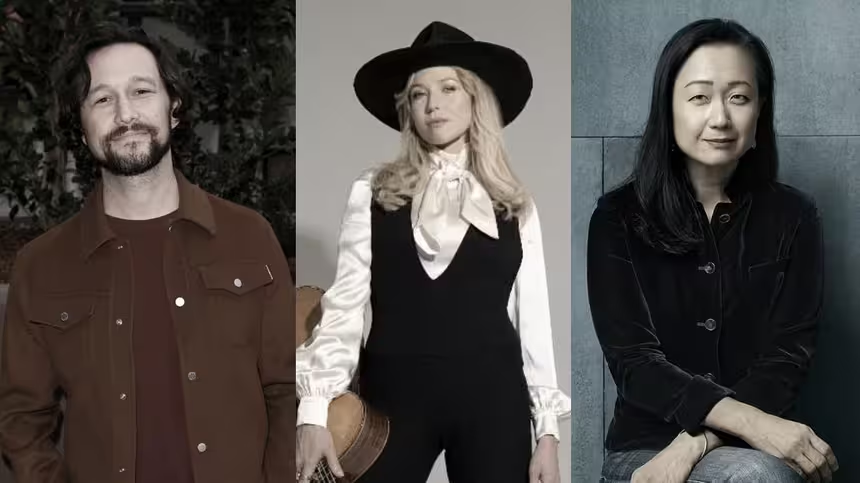
A front row seat to the creative process
How do today’s masters create their art? Each episode an artist reveals how they brought their creative work to life. Hear from artists across disciplines, like actor Joseph Gordon-Levitt, singer-songwriter Jewel, author Min Jin Lee, and more on our podcast "American Masters: Creative Spark."Providing Support for PBS.org
Learn Moreabout PBS online sponsorshipMore from This Collection
Watch curated interviews from The American Masters Digital Archive. The full collection includes over 1,000 hours of never-before-seen, raw interviews: a treasure trove of the movers and shakers of American culture, including Maya Angelou, Patti Smith, Mel Brooks, Carol Burnett, Matthew Broderick, Carl Reiner, Joan Rivers, Dionne Warwick, Lee Grant, Sidney Lumet, Betty White and many others.
Harvey Fierstein on gay representation on Broadway and its deep history
Video has Closed Captions
Harvey Fierstein talks to director Michael Kantor backstage during the production of "Hairspray." (13m 8s)

Video has Closed Captions
Ringo Starr describes his friendship with Mae West. (10m)
Mel Brooks' wild ride to his first Broadway show ever
Video has Closed Captions
Mel Brooks talks about the first Broadway show he ever saw—Cole Porter's "Anything Goes." (5m 44s)
John Kander and Fred Ebb on “Cabaret,” creativity and collaboration
Video has Closed Captions
Composer John Kander and lyricist Fred Ebb talk about how they have worked together. (5m 56s)
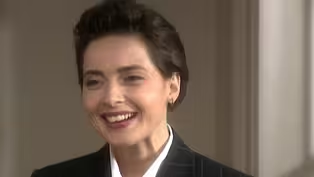
Isabella Rossellini compares her acting and modeling
Video has Closed Captions
Isabella Rossellini discusses her acting versus modeling career. (28m 24s)

Quincy Jones explains how he got started in music
Video has Closed Captions
Quincy Jones discusses his early career, friendships and how he defines himself. (15m)
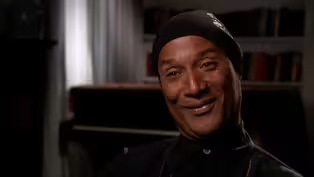
Paul Mooney on his career and relationship with Richard Pryor
Video has Closed Captions
Paul Mooney reflects on the mechanics of stand-up and his role as Richard Pryor's best friend. (10m 39s)
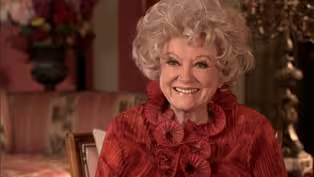
How Phyllis Diller broke down the doors for female comics
Video has Closed Captions
Phyllis Diller reflects on how her comedy was a response to years of “take my wife” jokes. (11m 35s)
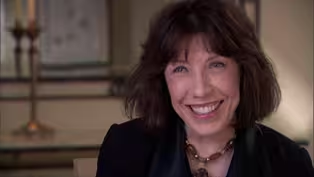
How Lily Tomlin found liberation in exploring her Laugh-In characters
Video has Closed Captions
Lily Tomlin speaks about her time on Laugh-In and how she developed her characters. (12m 35s)
Jeff Foxworthy on how every American might be a "redneck"
Video has Closed Captions
Jeff Foxworthy discusses regionalism in comedy and why "redneck" is a state of mind. (15m 41s)
Joan Rivers finds humor in being yourself
Video has Closed Captions
Joan Rivers speaks about her experience as a female comic in the early 60s. (9m 59s)
Conan O’Brien gets serious about silliness
Video has Closed Captions
Conan O’Brien speaks about his style of late night and his reason for doing comedy. (15m 32s)
Providing Support for PBS.org
Learn Moreabout PBS online sponsorship- All of our hopes in the 60s wind up on the floor of a place in Venice, listening to the bowling finals (John laughing) and whale music in the bathroom.
It's whatever happened to us.
It's the American dream.
- [Interviewer] Yeah.
(John laughing) - We had a luxury of about a two or three, two or three days, about two or three week rehearsal period, which was a gas.
It was a lot of fun.
Man, I don't even remember where it was now, but we'd just get together every day, start reading the script, and then Jeff would start picking it apart with annoying questions.
Very detailed stuff.
He's a very curious lad.
No, he just wanted to know everything.
And then we'd get into it and read.
Just read, read, read, read, read, read.
And details that I would overlook, I mean, or just stuff that I wouldn't even think to ask about, he had this curiosity about and just picked stuff apart, really detailed stuff.
- [Interviewer] Was it helpful to you as well?
- No, it was annoying, but... It was, no, it was, if it was helpful for Jeff, it was gonna be great for everybody.
I mean, it's just my brain doesn't work that way, but I'm glad his does.
- [Interviewer] So, okay, so.
Thought you were gonna continue on about the... So you did these long reads?
- Yeah, we had, and, you know, wound up paying off because people still come up to me and ask me how much was improvised, which, of course, was nothing.
The only line that I recall that the Coens didn't write in any of the films that I've worked with him was Jeff's, I think he called "The Big Lebowski" a human paraquat.
And he did that in rehearsal, and they put it in.
- [Interviewer] But the Coens don't mind it if it- - You're not gonna do better than what's on the page.
- No, that's true.
- You're just not.
Nobody's that good.
You can bring it up in rehearsal, but, you know, if they don't dig it, they won't go with it or come up with an idea.
But for me, why bother?
It's everything they put on the page is gold.
Yeah.
- [Interviewer] Did you sense what this film was going to sort of be in terms of the resonance that just has had?
- No, absolutely not.
It just looked like, you know, an homage to Raymond Chandler in Southern California and hippies and pot.
We... With some Vietnam stuff thrown in.
It was a funny script, but I didn't know it'd be a cult classic.
- [Interviewer] So in the process of it, so you did this long rehearsal, then you're in it.
The scenes themselves do feel very improvisational.
- They set- the way things are set up there, you wandering off the street, you feel pretty much at home.
It's just the way that they set things up with the dialogue, with everybody else that are working together as a team.
You're one of them.
You're right in the mix.
- [Interviewer] Do you have any, I mean, is there anything... How do I wanna say this?
The Coens' casting process, did he- - They wrote it for me.
That's what they told me.
You know, like, a year or so ahead, Ethan would be telling me, "Well, we got something for you."
And I think I read a draft earlier.
And I was just gung ho for it.
- [Interviewer] Did you have a sense then who Lebowski would be?
- No, absolutely not.
I know that "The Big Lebowski," they wanted Marlon Brando.
- [Interviewer] That would've been amazing.
- That would've been.
We'd still be working on it.
I mean, with all due respect.
But Marlon Brando, he's one of my heroes, but he got to be a little difficult.
- [Interviewer] So when you learned it was Jeff, was this the first encounter that you had in working with Jeff?
- I've loved him ever since he was one of the Beach boys.
Yeah, I was always blown away by him because he changes so much from picture to picture.
And yet he retains that essence, equality of honesty and earnestness.
He's an amazing guy.
He's chameleon-like, to the point where after the picture was wrapped about nine months later, I think we did a photo shoot for "Esquire" magazine.
And... Jeff showed up and I didn't know him.
He was a totally- he was Jeff Bridges, actor.
I just, it was a new guy, and it kind of hurt.
It just kind of, "Where's the dude," you know?
Or, "Where's the guy I knew?"
He just wasn't there.
He was onto something else, I guess.
But he just, he, you know, he cleaned up real good, and I missed the dude.
- [Interviewer] How long do you hold on to these characters in your own heart?
- Well, you can't, I can't hold on to the characters forever.
I'd like to, but, you know, things move on.
And it would get a little weird if I did that.
- [Interviewer] But the two of you, you're very chameleon-like, too.
You have an extraordinary range yourself.
So there's an interesting, that's an interesting coming together at that moment.
And it was an excellent coming together at that moment.
- Yeah, it worked out well.
I thought we worked pretty good together.
We did another film called "Masked and Anonymous" that Bob Dylan wrote and Larry Charles directed.
And the last night of shooting, it was, I mean, it was getting on to maybe five in the morning.
It was really late, and we had to pull the plug.
And we were trying to do way too much stuff for the time we had left.
And Jeff, we were all tired, and Jeff started calling me Walter.
"Walter, come on, we gotta, just try to hold on."
And I just drop my head and laugh and just let it go.
- [Interviewer] Process between the two of you.
Just even in "Lebowski," certainly, but even then.
And you don't have many scenes together then.
It's not the same kind of intensity of scenes together in "Masked and-" - No, it- - I mean, the two- - It was totally different.
It was a different animal.
But in "Lebowski," we both wanted the same thing, which was to make the scenes sparkle and... - [Interviewer] Did you stay entirely?
I mean, were you entirely in that character all the time?
- No, no.
I don't do that.
I'm uncomfortable doing it.
Jeff though maybe was on another level.
I mean, he was... You know, everything that we did was related to, for the good of the project.
It was just, we were in pitching together.
And I think that's why everything we did felt great.
- [Interviewer] It feels so natural.
Every bit of it felt so natural that it did feel like there was a great abiding print due to bides.
There was a great, really abiding- - Well, it was a real friendship because Walter was such a pain in the ass.
And you know, The Dude had to love him just to put up with him.
And most of the other guys in the film, you know, The Dude just gets by.
The Dude abides.
That's what The Dude does.
It's just because of Jeff's nature, the way I work as an actor, and the script, it all showed up on screen.
Everything was there.
- [Interviewer] Well, it's an extraordinary film kind of in the cannon of modern filmmaking, I think.
You know, although it was not critically acclaimed, and it was one, you know, that thing, these are really enduring characters.
Dude, of course, is an extraordinary life force character, but- - And marijuana.
- [Interviewer] Yes, it was.
It was a great pan to pot.
- Yeah.
But it's a lot to be said for Joel and Ethan.
The mishmash, the styles that came together in the film, the detective stuff.
Stay out of Base City, stay out of Malibu, whatever it was.
And he's one of the authors of the (indistinct).
(John laughing) His background is erratical, if it's true.
He might've been, he might've forgot about it, I don't know.
But, and his avid bowling skills.
It's a hell of a character.
It really is.
And he... He really breathed life into it and ran with it.
- [Interviewer] And the fact that it just cracks you up like this right now.
- Well, it's just the, it's the hope, all of our hopes in the 60s wind up on the floor of a place in Venice, listening to the bowling finals (John laughing) and whale music in the bathroom.
Oh man.
And the introduction of the marmot into the bathtub.
"Hey man, nice marmot."
That was, he's created a character for all time.
- [Interviewer] He did.
It was a character of all time.
- It's whatever happened to us.
It's the American dream.
- [Interviewer] Yeah.
(John laughing) I must tell you, I had exactly, when I sat and read this last night, I was laughing the sort of the same way.
It is so hilarious to read it.
And it's so, it must have been so, obviously, so hilarious to do it.
- Oh yeah, it was- - Well, how do you stop from, if this- - Well, it was horrible.
The most horrible time was you didn't want to crack up.
I didn't wanna crack up in front of Jeff 'cause he's such a pro, you know, show any weakness.
But when Turturro was walking around with a sack full of bird seed between his legs in the tight pants, and it just, I couldn't look at him.
But, you know, I forced myself and that was the hardest part.
Turturro almost killed me.
I think he took four years off my life.
- He was hilarious.
- Yeah.
- [Interviewer] Really hilarious.
I can't, I think you've done it.
I mean, I think you've- - Oh, thanks.
I just, you know, I got nothing else to say except I did... Anything that Jeff does, I'll watch because he is a true actor's actor.
And he's been that way since the first time I saw him was in "Fat City."
And it just, man, you know, I wanna be this guy.
There's no agenda, no background.
He just, he lives on film.
And it's a wonderful thing to see.
And he's a hell of a guy.








Support for PBS provided by:
Support for American Masters is provided by the Corporation for Public Broadcasting, AARP, Rosalind P. Walter Foundation, Judith and Burton Resnick, Blanche and Hayward Cirker Charitable Lead Annuity Trust, Koo...